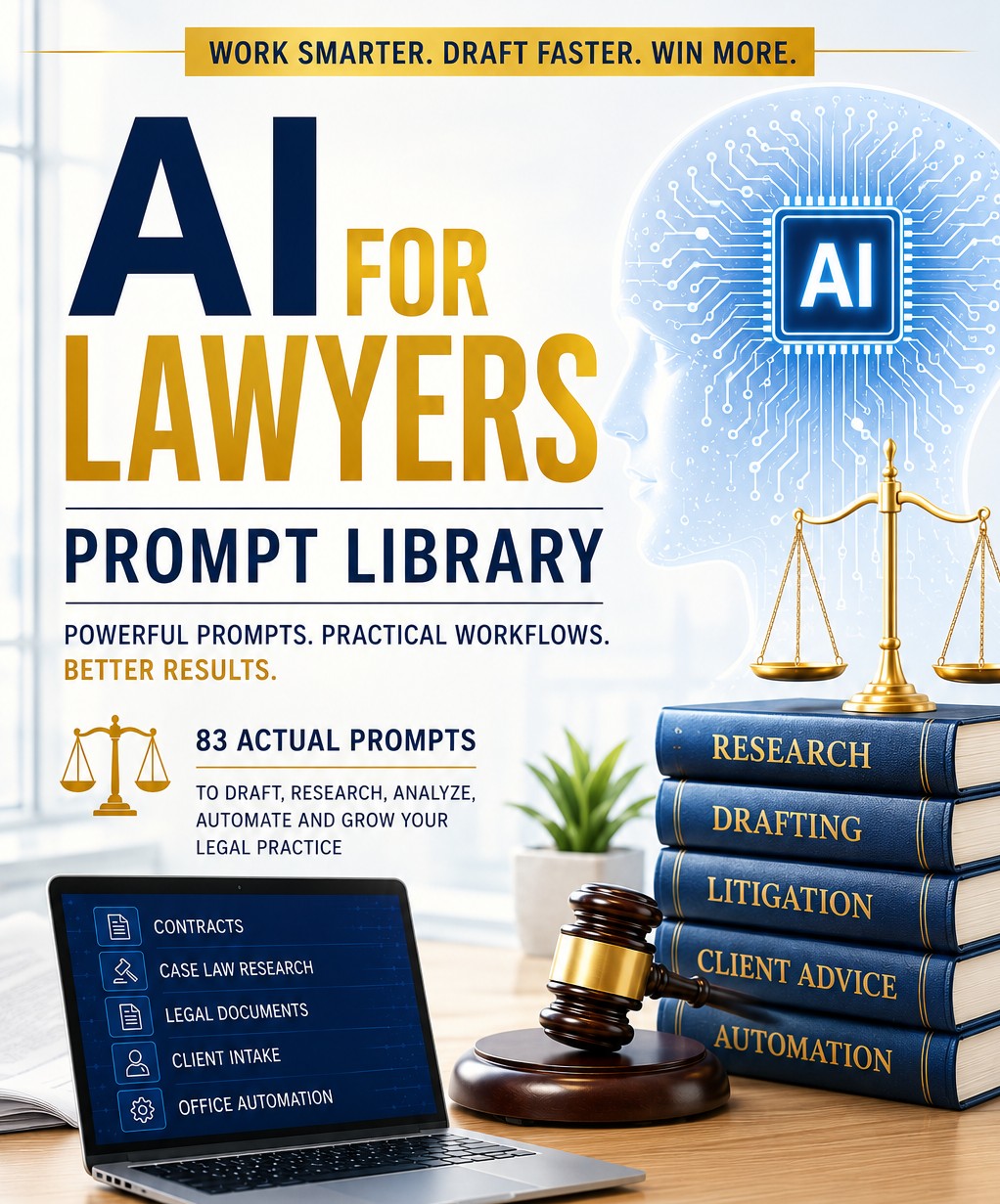
The Nigerian Lawyer’s Guide to AI: A Complete Prompt Library for Smarter Legal Work
The Nigerian Lawyer’s Guide to AI: 83 Legal Prompts
Artificial intelligence is changing the way legal services are delivered. Across the globe, law firms are using large language models to draft documents, summarise case files, conduct first-pass research, and improve client communication. Yet for many Nigerian practitioners, the gap between hearing about AI and actually using it effectively remains wide. The reason is simple: the quality of what comes out of an AI tool depends almost entirely on the quality of the instruction that goes in.
This article introduces a resource we have built to close that gap – the AI for Lawyers Prompt Library. It is a collection of 83 carefully designed, practice-ready prompts built specifically for the Nigerian legal system. Whether you are drafting a Statement of Claim, reviewing a commercial lease, writing a legal opinion on a property title, or preparing a client update after a court sitting, there is a prompt in the library that will give you a running start.
By the end of this article, you will understand how the library is structured, the ethical safeguards embedded in every prompt, and how to start using these templates to make your practice more efficient without compromising on quality. You will also find sample prompts from each chapter so you can see the level of detail and localisation that sets this resource apart.
Why Prompts Matter
Think of an AI tool as a brilliantly fast but literal-minded junior colleague. If you hand that colleague a file and say, “Summarise this,” you will get something back – but it may not be what you need. If instead you say, “Summarise the key obligations of the buyer in this asset purchase agreement. Highlight conditions precedent, indemnification caps, and survival periods. Present the summary under bold section headings in plain English,” you will get a far more useful result.
Prompting is the skill of giving the AI exactly the right context, role, structure, and caveats to produce a draft that you can actually work with. The library turns that skill into a set of reusable templates. Each template tells the AI who it is (e.g., “You are a senior litigation associate at a Nigerian law firm”), who the audience is, what format to use, and what verification steps are needed.
More importantly, each prompt is designed for the Nigerian jurisdiction. That means references to the Companies and Allied Matters Act 2020, the Administration of Criminal Justice Act 2015, the Land Use Act, the Matrimonial Causes Act, the Rules of Professional Conduct for Legal Practitioners 2007, and the Nigeria Data Protection Act 2023 – not generic common law principles that do not reflect our statutes and court rules.
How the Library Is Built
The library is organised into ten chapters, moving from foundational principles through to advanced techniques. Here is what you will find in each.
Chapter 1 – Introduction and Best Practices sets the ethical and practical ground rules. It contains prompts that remind you to anonymise client information before using a public AI tool, that check any scenario for potential rule violations under the RPC, and that systematically verify AI output for hallucinated citations. If you use nothing else, these seven prompts will help you stay on the right side of your professional obligations.
Chapter 2 – Legal Research helps you extract value from case law and statutes. Prompts like “Single Opinion Deep Summary” and “Statutory Text Parsing with Canons” guide the AI through structured analysis. The “State Law Doctrine Synthesis” prompt, for instance, asks the AI to produce a neutral overview of a legal doctrine in a particular state, with a prominent warning that all citations must be independently validated. This is research scoping, not a replacement for LawPavilion, but it saves hours at the start of a matter.
Chapter 3 – Contract Drafting and Review covers clause generation, contract summarisation, red flag identification, and plain-language translation. One prompt, “Standard Clause Drafting with Options,” instructs the AI to draft a clause (e.g., an indemnification provision) with three bracketed alternatives – pro‑drafter, neutral, and pro‑counterparty – followed by a drafting note that explains the legal effect of each. This turns a single instruction into a negotiation tool.
Chapter 4 – Litigation Support reflects Nigerian civil procedure. It includes prompts for drafting a Statement of Claim with frontloaded documents under the applicable High Court Rules, a Statement of Defence with proper traverse, an application for interrogatories, a motion on notice with supporting affidavit and written address, and even a cross‑examination outline drawn from an opposing witness statement on oath. These templates do not replace the lawyer’s strategic judgment, but they eliminate the blank‑page problem.
Chapter 5 – Client Communication addresses the duty to keep clients informed in language they understand. Prompts like “Client Friendly Explanation of a Nigerian Legal Process” convert complex procedures – obtaining Letters of Administration, perfecting a title, enforcing a fundamental right – into plain, conversational English that a secondary‑school‑educated client can follow. There is also a template for the standard Nigerian engagement letter that covers scope of services, fee structure, termination, and data protection.
Chapter 6 – Corporate and Transactional Work is built for the commercial lawyer. It includes a full‑scope due diligence request list for a Nigerian private company, a term sheet comparison tool, and templates for incorporation documents under CAMA 2020. The compliance policy prompts – an Anti‑Bribery and Corruption Policy aligned with the ICPC and EFCC Acts, and a Nigeria Data Protection Act 2023 compliance suite – are particularly useful for in‑house counsel and firms advising regulated businesses.
Chapter 7 – Legal Writing and Editing deals with the craft of persuasive legal writing. The “Final Written Address” prompt produces a structured skeleton for a Nigerian court, with issues for determination, summaries of evidence, and argument sections that tie law to facts. There are also prompts for citation formatting (NWLR style), table of authorities generation, and a meticulous proofreading tool that flags inconsistencies in defined terms, cross‑references, and tone.
Chapter 8 – Practice Area‑Specific Prompts dives into six core fields: Family Law, Real Estate, Employment Law, Intellectual Property, Criminal Law, and Immigration. For family practitioners, there is a petition for dissolution of marriage under the Matrimonial Causes Act. Real estate lawyers will find a Deed of Assignment template and a legal opinion on title prompt that flags missing Governor’s Consent. The criminal law prompts include a bail application and a no‑case submission, both grounded in the ACJA.
Chapter 9 – Legal Operations and Practice Management is for the running of the firm itself. Prompts convert time entries into professional fee notes, prepare detailed bills of costs for taxation, generate monthly matter status reports, and help you annotate and manage a bank of precedents so institutional knowledge does not walk out the door.
Chapter 10 – Advanced Prompt Techniques is where you move beyond single‑task prompts. It introduces chain‑of‑thought reasoning (showing your work, step by step), multi‑document comparison (e.g., analysing contradictions between two affidavits), prompt chaining for multi‑step workflows (like turning raw title documents into a client‑ready legal opinion through four sequential prompts), and custom templates with variables that you can save and reuse.
Sample Prompts from the Library
To give you a concrete sense of the resource, here are three sample prompts drawn from different practice areas. Each includes the use case, the prompt template, and a note on verification.
Sample 1: Statement of Claim (High Court of Lagos State)
Use Case: You have taken detailed instructions and identified the cause of action. You need a structured Statement of Claim that complies with the frontloading rules.
Prompt Template:
You are a legal practitioner practising in Lagos State and appearing before the High Court of Lagos State. Draft a Statement of Claim using the applicable Civil Procedure Rules. Suit No: [to be inserted]. Parties: [names and addresses]. Jurisdiction: [basis]. Facts (chronologically): [list key events]. Reliefs sought: [list]. Draft the Statement of Claim with: heading, endorsement on the Writ (if required), numbered paragraphs each containing a single material fact, particulars of special damages pleaded separately, prayer for relief (Whereof clause), and a verification clause. After the draft, add a checklist of documents to be frontloaded: witness statements, list of witnesses, copies of documents, pre‑action protocol letter, and verifying affidavit.
Verification Note: Ensure the facts are within the client’s personal knowledge. Strike any inference the AI may have added. The checklist must match the exact rules of the court.
Sample 2: Due Diligence Request List (Nigerian Private Company)
Use Case: You are acting for a buyer or investor and need a comprehensive document request list.
Prompt Template:
Act as a Nigerian corporate lawyer conducting legal due diligence on a target company incorporated in Nigeria. Prepare a detailed document request list organised under: Corporate Records (CAC forms, statutory registers, status report), Share Capital, Directors, Financing, Material Contracts, Real Property (distinguishing titled, Deed of Assignment with Governor’s Consent, and family land), Intellectual Property, Employment (including expatriate quota compliance), Regulatory Licences, Litigation, Tax, and Environmental. For each head, list specific documents by reference to Nigerian legal requirements. Add a section on “High‑Risk Areas in Nigerian M&A” (FCCPC consent, SEC approval for public companies, expatriate quota, Governor’s Consent).
Verification Note: The checklist is a starting point. Supplement with sector‑specific items (e.g., DPR permits for oil and gas). Never rely solely on AI to identify all required consents.
Sample 3: Bail Application (Federal High Court)
Use Case: You represent a defendant charged with a non‑capital offence and wish to apply for bail pending trial.
Prompt Template:
Draft an application for bail pending trial for the Defendant in Charge No [No] before the [Court]. Grounds: the offence is bailable; the Defendant will not jump bail and has sureties of means; the Defendant has a fixed address and known occupation; there is no risk of witness interference. Draft: (a) Motion on Notice for bail; (b) Affidavit in Support with facts; (c) Written Address citing ACJA sections 158‑165 and cases such as Bamaiyi v. State, arguing that bail should be granted on liberal terms. Propose conditions: bail in the sum of N[amount] with [number] sureties who are civil servants of Grade Level [X] or property owners within the jurisdiction.
Verification Note: The affidavit must contain true facts. Verify the surety’s credentials before presenting them in court. The court has full discretion; the prompt provides a strong starting argument, not a guarantee.
These three examples represent the level of detail and localisation you will find across all 83 prompts.
Ethical Safeguards in Every Prompt
We have not shied away from the risks of AI in legal practice. The library’s first chapter is dedicated entirely to ethics and verification. Every prompt is built with the understanding that:
- Confidentiality is paramount. Prompts include reminders to anonymise client details before using public AI tools and to use only firm‑approved, private instances for sensitive matters.
- The lawyer remains responsible. Under Rule 5.3 of the RPC 2007 and its common law equivalents, you must supervise all work product. The AI is an assistant; you are the legal practitioner.
- Citations must be verified. AI models sometimes generate plausible but entirely fabricated case names and citations. The library provides a Citation Extraction and Validation prompt to help you systematically audit every reference before it goes anywhere near a court filing.
- Bias and missing authority checks are built in. Several prompts ask the AI to argue the opposite side or identify omitted lines of authority, ensuring you do not walk into court with a one‑sided argument.
Using AI responsibly does not mean avoiding it. It means using it deliberately, with structure and safeguards. That is exactly what the library enables.
How to Get the Full Library
The AI for Lawyers Prompt Library – all ten chapters, 83 prompts, complete with use cases, examples, and cautions – is available now.
Download the Full Prompt Library
We are also offering in‑house training sessions and webinars for firms and legal departments that want to integrate AI into their workflows effectively and ethically.
A Final Thought
The conversation about AI in law is often caught between extremes: utopian visions of fully automated law firms and dire warnings about robots replacing lawyers. The reality is far more practical and far more exciting. AI is a tool. In the hands of a skilled lawyer who knows how to instruct it, it can remove hours of drudgery, sharpen arguments, and free up time for the strategic, empathetic, and profoundly human work that clients actually pay for.
Our prompt library is an invitation to start that journey – not with vague tips, but with concrete, battle‑ready templates that work in the courts, boardrooms, and registries where you practice every day.
Start using AI deliberately. Start using it with confidence. Start today.
Related Articles

Unauthorized Use of Online Content Under Nigerian Law

How to Get Free Legal Services in Nigeria

The Scourge of Undercharging and Fee Undercutting in the Nigerian Legal Profession