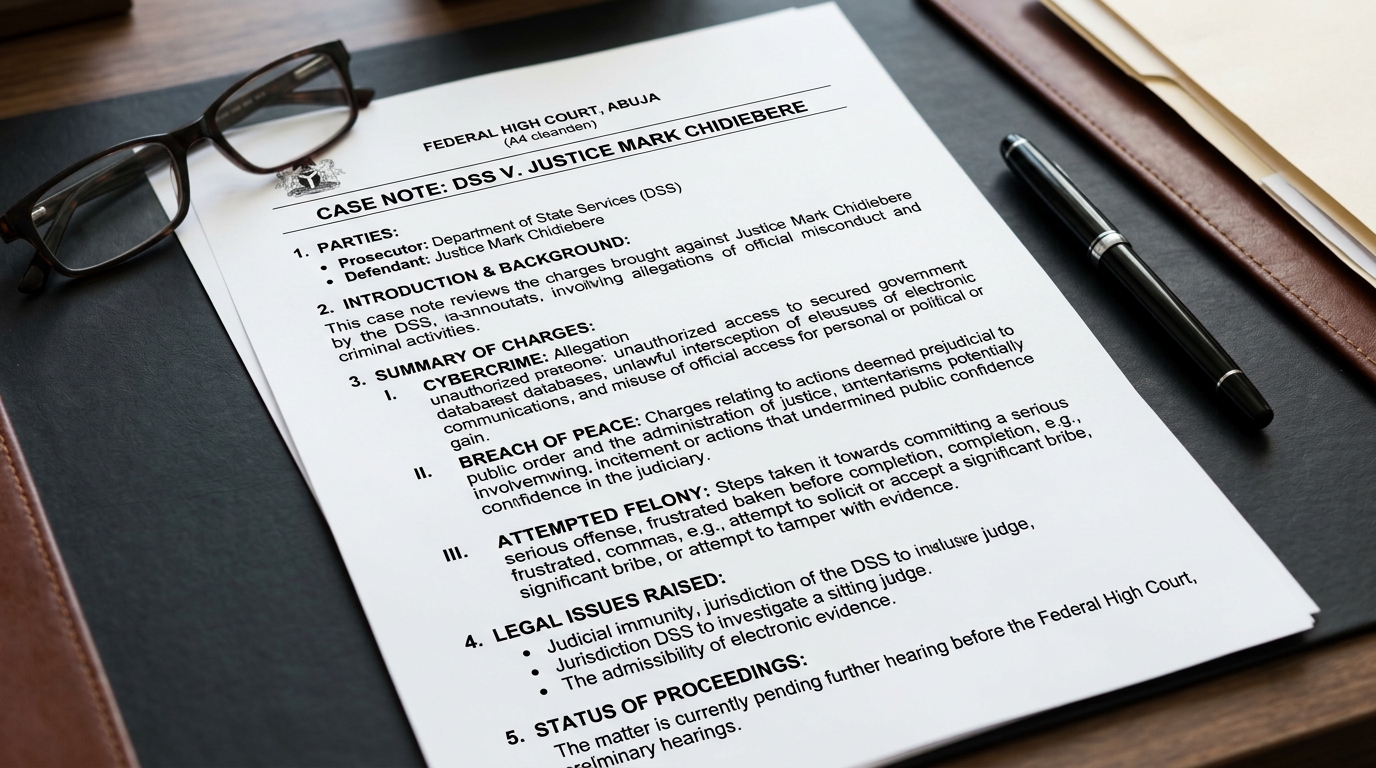
CYBERCRIME, BREACH OF PEACE, AND ATTEMPTED FELONY: A CASE NOTE ON DSS V. JUSTICE MARK CHIDIEBERE
CYBERCRIME, BREACH OF PEACE, AND ATTEMPTED FELONY: A CASE NOTE ON DSS V. JUSTICE MARK CHIDIEBERE
ABSTRACT
On 4th May 2026, Justice Mark Chidiebere, popularly known as “Justice Crack,” was arraigned before Justice Joyce Abdulmalik at the Federal High Court, Abuja, on a three-count charge filed by the Department of State Services (DSS). He pleaded not guilty to all counts and was remanded in DSS custody until 25th May 2026. This article examines each charge against the legal framework of Nigerian law, analyses whether the charges hold water, cites relevant decided cases, and assesses the broader implications for free speech and fundamental rights in Nigeria.
1. INTRODUCTION
The criminal prosecution of Justice Crack represents the latest chapter in a case that began with his arrest by the Nigerian Army on 28th April 2026. Following public outcry and the Army’s admission that it lacked jurisdiction to detain a civilian, the Army transferred him to the DSS, which subsequently filed charges before the Federal High Court.
The charges, while formally brought under the Cybercrimes Act and the Criminal Code Act, raise fundamental questions about the criminalisation of public interest speech, the tension between national security concerns and freedom of expression, and the proper limits of criminal law in a democracy.
This article analyses each count in seriatim, examining the statutory elements of each offence, the actual position of Nigerian law as established by binding judicial precedents, and the likelihood that the charges will withstand judicial scrutiny at trial.
2. COUNT ONE: CYBERCRIME (FALSE INFORMATION)
2.1 The Allegation
Count One alleges that on or about 28th April 2026, Justice Crack circulated information to the public via his X handle, @JusticeCrack, regarding the alleged inadequate feeding of Nigerian Army personnel.
The prosecution alleges that he knew this information to be false but posted it for the purpose of causing annoyance, ill-will, and hatred, especially among citizens who hold divergent views.
This offence is said to be contrary to Section 24(1)(b) of the Cybercrimes (Prohibition, Prevention, etc.) Act, 2015 (as amended).
2.2 The Statutory Provision
Section 24(1)(b) of the Cybercrimes (Prohibition, Prevention, etc.) Act, 2015 provides that any person who:
“knowingly or intentionally sends a message or other matter by means of computer systems or networks that he knows to be false, for the purpose of causing annoyance, inconvenience, danger, obstruction, insult, injury, criminal intimidation, enmity, hatred, ill will or needless anxiety to another or causes such a message to be sent”
commits an offence under the Act.
2.3 Decided Cases on Section 24(1)(b)
The Nigerian courts have had occasion to interpret and apply Section 24(1)(b) of the Cybercrimes Act in several cases. Two notable cases are particularly instructive:
The Case of Seun Oloketuyi (2015)
In August 2015, the Nigerian Police arraigned Seun Oloketuyi, a publisher of a news website (naijahottestgist.com), before the Federal High Court, Lagos, on a two-count charge. The prosecutor alleged that the accused knowingly and intentionally published a defamatory story on the internet against Nnamdi Okonkwo, the Managing Director of Fidelity Bank Plc, in order to annoy and insult him. The prosecutor further alleged that the accused knew that the information he published was false.
The first count of the charge was specifically brought under Section 24(1)(b) of the Cybercrimes (Prohibition Prevention) Act, 2015, alleging that the accused “intentionally sent message and other matters by means of computer system or network against Okonkwo, which he knew to be false, for the purpose of causing him annoyance, insult and ill-will”.
Justice Mohammed Yunusa remanded the accused in Ikoyi prison and adjourned the case. This case demonstrates that the prosecution has, in practice, invoked Section 24(1)(b) against individuals for online publications alleged to be false and intended to cause annoyance.
Significance for Justice Crack’s Case:
The Oloketuyi case establishes that charges under Section 24(1)(b) are not unprecedented. However, it is important to note that the Oloketuyi case did not proceed to a final judicial determination on the interpretation of the section; it was resolved at the bail stage. The substantive elements of the offence, particularly the requirement of subjective knowledge of falsity and specific intent, were not judicially determined.
2.4 The Actual Position of the Law
The Mens Rea Requirement: Knowledge of Falsity
The most critical element of Section 24(1)(b) is the requirement that the accused knew the information was false. The section uses the phrase “he knows to be false”. This is a subjective test: the prosecution must prove that Justice Crack had actual knowledge that his statement about inadequate feeding was false at the time he posted it.
This is a high evidentiary burden. The prosecution cannot merely show that the statement was false; they must prove that Justice Crack knew it was false. If he honestly believed the information to be true (even if mistaken), the mental element of the offence is not satisfied.
The Purpose Element: Intent to Cause Annoyance, Ill-Will, or Hatred
Even if the prosecution proves knowledge of falsity, they must also prove that Justice Crack acted “for the purpose of causing annoyance, inconvenience, danger, obstruction, insult, injury, criminal intimidation, enmity, hatred, ill will or needless anxiety to another”.
This is a specific intent requirement. The prosecution must show that Justice Crack’s dominant purpose was to cause one of these specified negative outcomes, not to inform the public, expose wrongdoing, or advocate for better soldier welfare.
2.5 Does This Charge Hold Water?
The Case for the Prosecution:
The prosecution will likely argue that the statement about inadequate feeding was false (if they can prove this through military records or testimony) and that Justice Crack either knew it was false or deliberately avoided verifying it before publication. The Oloketuyi precedent suggests that Nigerian prosecutors have successfully initiated charges under this section for similar allegations.
The Case for the Defence:
The defence has several strong arguments:
- Lack of Knowledge of Falsity: Justice Crack is a social media commentator, not a military whistleblower with access to classified feeding records. If he obtained his information from soldiers’ complaints (as the Army’s earlier statement suggested), he may have honestly believed the information to be true. The Army’s own initial investigation was triggered by soldiers’ complaints about feeding and welfare. If soldiers themselves were complaining, how can a civilian who amplifies those complaints be said to “know” the complaints are false?
- Legitimate Public Interest Purpose: The predominant purpose of the publication appears to be drawing public attention to soldiers’ welfare conditions, not causing annoyance or ill-will for its own sake. Discussing the welfare of security personnel is a matter of public interest. If the dominant purpose is public interest advocacy, the specific intent required by Section 24(1)(b) may be absent.
- Constitutional Free Speech Protection: Section 39 of the 1999 Constitution guarantees freedom of expression. In interpreting penal statutes that restrict free speech, courts apply a presumption in favour of liberty and require strict proof of all elements.
Verdict on Count One: Uncertain but Challenging for Prosecution
The charge is not frivolous, but the prosecution faces significant evidentiary hurdles. Proving subjective knowledge of falsity and specific intent to cause ill-will (rather than to inform) is notoriously difficult. If the defence can show that Justice Crack had reasonable grounds for believing his statement was true and that his purpose was public interest advocacy, the charge may fail.
3. COUNT TWO: BREACH OF PEACE
3.1 The Allegation
Count Two alleges that Justice Crack published a viral video and accompanying statements about the Nigerian Army which generated widespread negative reactions and were likely to cause fear and a breach of public peace.
This charge is brought under Section 59 of the Criminal Code Act.
3.2 The Statutory Provision
Section 59 of the Criminal Code Act states:
“Any person who, by writing, printing, or any other means, publishes or circulates any statement or report which is likely to cause fear and alarm to the public or to disturb the public peace, is guilty of a misdemeanor.”
3.3 Decided Cases on Breach of Peace by Publication
While there are limited Nigerian appellate authorities directly on Section 59 of the Criminal Code, cases from other jurisdictions and related provisions provide guidance.
The YABATECH Bursar Case (2016)
In a related context, the Lagos State Directorate of Public Prosecutions arraigned the former Bursar of Yaba College of Technology, Mr. Olugbenga Ibirogba, for allegedly leaking classified information. The defendants were charged with the offence of “provoking breach of peace by offensive publication, contrary to Section 57(1)(b) of the Criminal Law of Lagos State 2011,” by circulating several threat letters against the person of the college rector.
They were also accused of violating Section 59 of the Criminal Law of Lagos State 2011 for leaking the college’s secret. This case demonstrates that Nigerian prosecutors have invoked similar “breach of peace” provisions in the context of publication offences, though the substantive interpretation of the section was not fully litigated.
3.4 The Actual Position of the Law
The “Likely” Standard
The offence requires that the publication be “likely to cause fear and alarm to the public or to disturb the public peace.” This is an objective test: would a reasonable person in the position of the public (or a segment thereof) be caused fear or alarm by the publication?
The test is not whether the publication actually caused fear or alarm, but whether it was likely to do so.
The “Public Peace” Requirement
“Public peace” refers to the absence of disorder, violence, or disturbance affecting the community at large. The offence is not concerned with private annoyance or individual discomfort, but with threats to public order.
3.5 Does This Charge Hold Water?
The Case for the Prosecution:
The prosecution will argue that the publication about inadequate feeding of soldiers, especially when coupled with the earlier allegations that soldiers were complaining about welfare conditions, was likely to cause fear and alarm among the public about the readiness and morale of the military.
The Case for the Defence:
The defence has several strong arguments:
- Legitimate Criticism Distinguished from Breach of Peace: Not every publication that causes negative reactions or controversy automatically constitutes a breach of peace. The law requires a specific likelihood of public fear and disturbance of public order. Criticism of government institutions, including the military, is protected speech under Section 39 of the Constitution.
- No Evidence of Actual Breach: The charge is based on what the publication was “likely to cause,” not on any actual breach of peace that occurred. In the absence of evidence that any public disorder actually resulted, the “likelihood” determination becomes highly speculative.
- Vagueness and Overbreadth Concerns: Section 59 is a broadly worded provision that, if interpreted expansively, could criminalise virtually any criticism of government institutions.
Verdict on Count Two: Weak Charge
This charge is on weaker footing than Count One. The connection between a report about soldier feeding and a likely breach of public peace is tenuous. Unless the prosecution can present evidence that the publication occurred in a context of particular volatility (e.g., during active mutiny or widespread civil unrest), it will struggle to prove that a reasonable person would have foreseen the publication causing public fear and disturbance of peace.
4. COUNT THREE: ATTEMPTED FELONY
4.1 The Allegation
Count Three accuses Justice Crack of attempting to commit a felony by publishing what the prosecution describes as derogatory video and statements about the Nigerian Army.
The charge is brought under Section 509 of the Criminal Code Act.
4.2 The Statutory Provision
Section 509 of the Criminal Code Act provides:
“Any person who attempts to commit a felony of such a kind that a person convicted of it is liable to the punishment of death or of imprisonment for a term of fourteen years or upwards, with or without other punishment, is guilty of a felony and is liable, if no other punishment is provided, to imprisonment for seven years.”
“Any person who attempts to commit a felony of any other kind is liable, if no other punishment is provided, to a punishment equal to one half of the greatest punishment to which an offender convicted of the felony which he attempted to commit is liable.”
4.3 Decided Cases on Section 509 and Attempted Felony
Mayaki v. Registrar, Magistrate Court (1990)
In Mayaki v. Registrar, Magistrate Court (decided 4th January 1990), the Court of Appeal had occasion to consider the nature of charges under Section 509 of the Criminal Code. The 3rd Respondent (accused person) was charged before the Magistrate Court for the offence of attempt to commit felony, to wit murder, contrary to section 509 of the Criminal Code Law of Lagos State.
The Appellants (complainants) applied to the Lagos High Court for orders of certiorari and prohibition, arguing that the Magistrate lacked jurisdiction to try the indictable offence of attempted murder. The court dismissed the application, and the appeal to the Court of Appeal was also dismissed.
The Court of Appeal held that:
“The offence with which the 3rd Respondent was charged as disclosed on the printed record of proceedings was attempted murder. It is an indictable offence. The accused person elected summary trial. The 2nd Respondent before whom the 3rd Respondent was arraigned was a Magistrate Grade I… The law gives a Magistrate Grade I power to impose a maximum sentence of three years. Therefore, as the law now stands all Magistrates other than a Magistrate Grade 3 have jurisdiction to try indictable offences in Lagos State subject to the accused person electing summary trial.”
The court further noted that while the Magistrate has jurisdiction to try the offence, “The Magistrate will however not be able to impose any punishment greater than that stated in Section 18(5)(c) of the Magistrates’ Court Law as amended”.
Significance for Justice Crack’s Case:
The Mayaki case establishes that a charge under Section 509 is procedurally valid and can be tried by a magistrate or high court. However, the case also underscores that for an attempt charge to be sustainable, the underlying felony must be clearly identified. In Mayaki, the underlying felony was “murder,” which was explicitly stated.
Rex v. Anthony Enahoro (1947) – Incitement Distinguished
While not directly on Section 509, the case of Rex v. Anthony Enahoro (1947) from the West African Court of Appeal provides important guidance on what constitutes incitement, which may be the underlying felony alleged in Justice Crack’s case.
The appellant was convicted under Section 44(a) of the Criminal Code for advisedly attempting to seduce members of the Nigeria Police Force from their duty and allegiance. He had uttered words at a public meeting suggesting that police should not fire on citizens in the event of a riot.
The Court of Appeal upheld the conviction but provided important interpretive guidance, distinguishing between Section 44(a) and Section 45(b) of the Criminal Code:
“The real distinction is between advisedly attempting to seduce members of the Police Force from their duty and allegiance, that is to say, a deliberate attempt so to seduce them generally should certain events arise, and attempting to induce them, possibly on the spur of the moment, to disobey a specific order given them by a superior officer. The first strikes at the very basis of duty and allegiance, so that whenever certain circumstances shall arise they shall fail therein. The second aims at securing disobedience to a specific order given at a particular time.”
The court held that to attempt to induce police to disobey their officers in the event of being ordered to quell a riot is an attempt to seduce them from their duty and allegiance to His Majesty.
Regarding the word “advisedly,” the court noted: “the word ‘advisedly’ as it appears in the relevant section… is equivalent to ‘knowingly'” .
Significance for Justice Crack’s Case:
The Enahoro case establishes a significant precedent: incitement requires a deliberate attempt to cause disaffection or disobedience, not merely criticism or commentary. The court specifically noted that the distinction is between “a deliberate attempt so to seduce them generally should certain events arise” and other forms of expression.
4.4 The Nwankwo Precedent: Constitutional Limits on Criminal Speech Laws
A crucial precedent that bears directly on the constitutional validity of charges like those against Justice Crack is Arthur Nwankwo v. The State (1985) 6 NCLR 228.
In that case, the Anambra State High Court convicted and sentenced Nwankwo to one year imprisonment for publishing a book which had exposed corrupt practices under Governor Jim Nwobodo of Anambra State. The Court of Appeal set aside the conviction and sentence on the grounds that section 51 of the Criminal Code which provided for sedition was illegal and unconstitutional.
Speaking for the court, Justice Olajide Olatawura (as he then was) held:
“We are no longer the illiterates or the mob society our colonial masters had in mind when the law was promulgated…To retain S. 51 of the Criminal Code, in its present form, that is even if not inconsistent with the freedom of expression guaranteed by our Constitution will be a deadly weapon to be used at will by a corrupt government or a tyrant…Let us not diminish from the freedom gained from our colonial masters by resorting to laws enacted by them to suit their purpose.”
Justice Olatawura further stated:
“The decision of the founding fathers of this present Constitution which guarantees freedom of speech which must include freedom to criticize should be praised and any attempt to derogate from it except as provided in the Constitution must be resisted. Those in public office should not be intolerant of criticism. Where a writer exceeds the bounds there should be a resort to the law of libel where the plaintiff must of necessity put his character and reputation in issue.”
Significance for Justice Crack’s Case:
The Nwankwo case is directly relevant and potentially fatal to the prosecution’s case. The Court of Appeal explicitly declared that sedition laws (and by extension, laws that criminalise criticism of government and its institutions) are inconsistent with the constitutional guarantee of freedom of expression. Senior Advocate of Nigeria, Femi Falana, has cited this case in calling for the withdrawal of criminal charges against critics of public officials.
Falana has argued: “In view of the cautionary words of the Court of Appeal in Nwankwo v The State (supra), it is submitted that the resort to criminal libel and sedition by public officers to settle scores with critics and political opponents is illegal in every material particular” .
The prosecution’s argument that Justice Crack’s publication constitutes an “attempted felony” (presumably incitement or sedition) must be considered in light of this binding appellate authority.
4.5 The Natasha Akpoti-Uduaghan Precedent (2025)
More recently, in 2025, Senator Natasha Akpoti-Uduaghan was charged with criminal defamation for allegedly defaming the Senate President. The Socio-Economic Rights and Accountability Project (SERAP) and Femi Falana (SAN) called for the immediate withdrawal of the charges.
SERAP argued that the charges violated Section 39 of the 1999 Constitution and Nigeria’s international obligations under the African Charter on Human and Peoples’ Rights. Falana specifically cited the Nwankwo case in his demand for withdrawal of the charges.
Significance for Justice Crack’s Case:
The Akpoti-Uduaghan case demonstrates that there is growing judicial and legal opinion that criminalising speech through laws like sedition, criminal libel, and related provisions is constitutionally suspect. While the case did not proceed to a final judgment, the legal arguments made by SERAP and Falana represent persuasive authority that courts may adopt.
4.6 The Actual Position of the Law
What Constitutes an “Attempt”?
Under Nigerian criminal law, an attempt to commit an offence consists of:
- An intent to commit the substantive offence (mens rea)
- An act done towards the commission of that offence (actus reus)
- That goes beyond mere preparation.
What is the Underlying Felony?
Critically, Section 509 is not a standalone offence. It creates liability for attempting to commit another felony. Therefore, to charge someone under Section 509, the prosecution must first identify the specific felony that the accused allegedly attempted to commit.
The charge sheet in Justice Crack’s case does not publicly specify which felony he is alleged to have attempted. The charge merely states that he attempted to commit a felony by publishing derogatory videos and statements about the military.
4.7 Does This Charge Hold Water?
The Case for the Prosecution:
The prosecution might argue that Justice Crack attempted to commit either inciting to mutiny (under Section 44 of the Criminal Code) or sedition. However, the Enahoro case requires proof of a deliberate attempt to cause disaffection, not merely criticism.
The Case for the Defence:
The defence has very strong arguments against this charge:
- Failure to Specify the Underlying Felony: For an attempt charge to be valid, the prosecution must clearly identify the substantive felony that was allegedly attempted. Unlike in Mayaki v. Registrar, where the underlying felony (murder) was explicitly stated, this charge does not appear to specify the underlying felony. This alone may render the charge defective.
- No Act Beyond Preparation: Even if an underlying felony were specified, the prosecution would need to prove that Justice Crack did an act “towards the commission” of that felony that went beyond mere preparation. Publishing a video about feeding conditions, without more, is likely to be characterised as preparation (or mere expression) rather than an attempt.
- Mere Expression is Not an Attempt: In a democratic society governed by the rule of law, mere expression of opinion, even harsh or derogatory opinion, does not constitute an attempt to commit a crime unless accompanied by acts that directly advance criminal objectives.
- The Nwankwo Constitutional Bar: The Court of Appeal in Nwankwo v. The State declared that criminalising speech that criticises government is unconstitutional. This binding precedent may render the entire basis of the charge invalid.
- Circularity Problem: If the publication itself is alleged to be the “act towards the commission” of an unnamed felony, and the publication is also protected speech under the Constitution, the charge becomes constitutionally suspect.
Verdict on Count Three: Very Weak Charge
This charge appears to be the weakest of the three. The apparent failure to specify the underlying felony is a potentially fatal defect. Even if that defect were cured, the Nwankwo precedent suggests that criminalising political speech through sedition or incitement laws may be unconstitutional. The Enahoro case requires proof of deliberate attempt to cause disaffection, a high standard that may not be met by merely reporting on soldier welfare.
5. COMPARATIVE ANALYSIS OF THE THREE CHARGES
Count |
Offence |
Statutory Provision |
Strength |
Primary Weakness |
Relevant Case Law |
|---|---|---|---|---|---|
One |
Cybercrime (false information) |
S.24(1)(b), Cybercrimes Act |
Moderate |
Proving subjective knowledge of falsity and specific intent |
Oloketuyi (2015) – established pattern of prosecution |
Two |
Breach of peace |
S.59, Criminal Code |
Weak |
Tenuous link to public peace disturbance; vagueness concerns |
Ibirogba (2016) – similar charge but not substantively interpreted |
Three |
Attempted felony |
S.509, Criminal Code |
Very weak |
No underlying felony specified; Nwankwo constitutional bar |
Mayaki (1990); Enahoro (1947); Nwankwo (1985) |
6. BROADER LEGAL AND CONSTITUTIONAL ISSUES
6.1 The Tension Between Free Speech and Criminal Law
The prosecution of Justice Crack highlights a recurring tension in Nigerian law: the use of criminal statutes to regulate online speech. As SERAP argued in the Akpoti-Uduaghan case, “Criminal defamation laws and lawsuits are inconsistent and incompatible with section 39 of the Nigerian Constitution and the country’s international obligations under the African Charter on Human and Peoples’ Rights and the International Covenant on Civil and Political Rights”.
6.2 The Nwankwo Doctrine
The Court of Appeal’s decision in Nwankwo v. The State (1985) established an important constitutional principle: sedition laws and laws that criminalise criticism of government are unconstitutional under Nigeria’s democratic framework. Justice Olatawura’s warning that such laws will be “a deadly weapon to be used at will by a corrupt government or a tyrant” remains prophetic.
6.3 The Role of Civil Remedies
One of the central critiques of using criminal law for speech-related offences is the availability of civil remedies. As Justice Olatawura stated in Nwankwo: “Where a writer exceeds the bounds there should be a resort to the law of libel where the plaintiff must of necessity put his character and reputation in issue”.
The Nigerian Army or the government could have sued Justice Crack for defamation in a civil court, seeking damages rather than imprisonment. The resort to criminal prosecution suggests, as some have argued, a desire to punish rather than merely to protect reputations.
6.4 The Burden of Proof
In all three counts, the prosecution bears the burden of proving every element beyond reasonable doubt. The high standard of proof in criminal cases is a significant protection for the accused. The defence does not need to prove innocence; it only needs to raise reasonable doubt as to any essential element.
7. POSSIBLE DEFENCES AND APPLICABLE CASE LAW
Justice Crack’s legal team may advance the following defences, supported by the cited case law:
- Truth/Reasonable Belief: If the statement about inadequate feeding of soldiers is true, or if Justice Crack had reasonable grounds for believing it to be true, the knowledge-of-falsity element of Count One is negated. The Army’s own investigation was triggered by soldier complaints, supporting this defence.
- Public Interest: The predominant purpose of the publication was public interest advocacy, not causing annoyance or ill-will. This negates the specific intent requirement under Section 24(1)(b).
- Constitutional Protection – Nwankwo Doctrine: Arthur Nwankwo v. The State (1985) 6 NCLR 228 establishes that criminalising criticism of government is unconstitutional. This is potentially the strongest defence against Counts Two and Three.
- Lack of Proximate Causation: The publication did not cause and was not likely to cause any actual breach of public peace, distinguishing this case from situations where there is clear evidence of public disorder.
- Defective Charge – Mayaki Principle: Following Mayaki v. Registrar, Magistrate Court (1990), a charge under Section 509 must specify the underlying felony. The apparent failure to do so may render Count Three legally defective.
- No Attempt – Enahoro Distinction: The Rex v. Enahoro (1947) case distinguishes between deliberate attempts to cause disaffection and mere commentary. Justice Crack’s conduct, if only reporting on welfare, falls on the commentary side of this distinction.
8. CONCLUSION
8.1 Summary of Findings
After a detailed analysis of each charge against the applicable provisions of Nigerian law and binding judicial precedents, the following conclusions emerge:
Count One (Cybercrime): This charge has legal substance based on the pattern established in Oloketuyi (2015). However, it faces significant evidentiary hurdles. Proving that Justice Crack knew the information was false and that his dominant purpose was to cause ill-will (rather than to inform the public) will be challenging for the prosecution.
Count Two (Breach of Peace): This charge is on weaker footing. The Ibirogba (2016) case shows that such charges have been brought, but the connection between a report about soldier feeding and a likely breach of public peace is tenuous. The Nwankwo doctrine also casts constitutional doubt on this charge.
Count Three (Attempted Felony): This is the weakest charge. The apparent failure to specify the underlying felony is a potentially fatal defect under the principles illustrated in Mayaki v. Registrar (1990). Even if cured, the Enahoro (1947) case requires proof of a deliberate attempt to cause disaffection, and the Nwankwo (1985) precedent may render criminalisation of such speech unconstitutional.
8.2 The Weight of Binding Precedent
The most significant legal authority favouring Justice Crack is Arthur Nwankwo v. The State (1985) 6 NCLR 228. The Court of Appeal’s declaration that sedition laws are “a deadly weapon to be used at will by a corrupt government or a tyrant” and that they are inconsistent with the constitutional guarantee of freedom of expression is binding on all lower courts.
Femi Falana (SAN) has properly invoked this precedent in calling for the withdrawal of criminal charges against critics of public officials, stating that “the resort to criminal libel and sedition by public officers to settle scores with critics and political opponents is illegal in every material particular”.
8.3 The Broader Implications
Regardless of the outcome of this specific case, the prosecution of Justice Crack raises important questions about the state of free speech in Nigeria. The use of criminal law to regulate online commentary about government institutions, particularly the military, has a chilling effect on public discourse.
The Nigerian courts have historically risen to the occasion when fundamental rights are threatened. The Court of Appeal did so in Nwankwo in 1985. The question is whether the Federal High Court in 2026 will follow that binding precedent and protect free speech rights in the digital age.
8.4 Final Assessment
To answer the central question: Do the charges hold water?
- Count One: Partially holds water, but the prosecution’s evidentiary burden is high.
- Count Two: Barely holds water; the link to public peace is weak, and the Nwankwo doctrine raises constitutional concerns.
- Count Three: Does not hold water; the charge appears legally defective and may be unconstitutional under Nwankwo.
The strength of the prosecution’s case will ultimately depend on evidence that has not yet been publicly disclosed. However, the binding precedents of the Court of Appeal, particularly Nwankwo v. The State, provide a robust legal framework for the defence to challenge the constitutionality of criminalising political speech.
What is clear is that this case will be closely watched as a test of Nigeria’s commitment to free speech, the rule of law, and the proper limits of criminal prosecution for online expression.
TABLE OF CASES CITED
| Case Name | Citation | Court | Relevance |
|---|---|---|---|
| Arthur Nwankwo v. The State | (1985) 6 NCLR 228 | Court of Appeal | Declared sedition laws unconstitutional; binding authority that criminalising criticism of government violates free speech |
| Rex v. Anthony Enahoro | (1947) LJR-WACA | West African Court of Appeal | Defines “advisedly” as “knowingly”; distinguishes between incitement and commentary |
| Mayaki v. Registrar, Magistrate Court | (1990) 4 January 1990 | Court of Appeal | Addresses Section 509 charges; requires underlying felony to be specified |
| Seun Oloketuyi | 2015 (unreported) | Federal High Court, Lagos | Demonstrates pattern of prosecution under Section 24(1)(b) |
| Olugbenga Ibirogba | 2016 (unreported) | Lagos State High Court | Demonstrates use of breach of peace provisions for publications |
REFERENCES
- Constitution of the Federal Republic of Nigeria, 1999 (as amended)
- Cybercrimes (Prohibition, Prevention, etc.) Act, 2015 (as amended 2024)
- Criminal Code Act, Cap C38, Laws of the Federation of Nigeria, 2004
- African Charter on Human and Peoples’ Rights (Ratification and Enforcement) Act, Cap A9, Laws of the Federation of Nigeria, 2004
- TheCable (2026). “DSS arraigns influencer over alleged attempt to incite soldiers”
- The Guardian (2026). “Alleged Cybercrime: DSS arraigns Chidiebere Justice Mark trial for May 25”
- The Eagle Online (2015). “Online Publisher remanded in prison for defamatory publication on Fidelity Bank MD”
- The NEWS Nigeria (2015). “Nigerian blogger sent to jail over malicious publication”
- Punch Newspapers (2016). “Ex-YABATECH bursar remanded for leaking college’s secret”
- Tribune Online (2025). “Withdraw criminal libel charge against Natasha , Falana tells FG”
- The NEWS Nigeria (2025). “Withdraw Charges Against Senator Natasha Akpoti-Uduaghan”
This article is provided for academic and informational purposes and does not constitute legal advice. The analysis is based on publicly available information and the applicable provisions of Nigerian law as of the date of publication. The author is not affiliated with any party to the litigation.
Related Articles

The Battle of the Logos: Defining the Limits of INEC’s Power in Political Party Registration

THE FEDERAL CHARACTER PRINCIPLE IN NIGERIA

Legislative Inaction and the Enforcement of Constitutional Governance in Nigeria