THE JURISDICTIONAL CONUNDRUM: ANALYSING THE DETENTION OF JUSTICE CRACK BY THE NIGERIAN ARMY
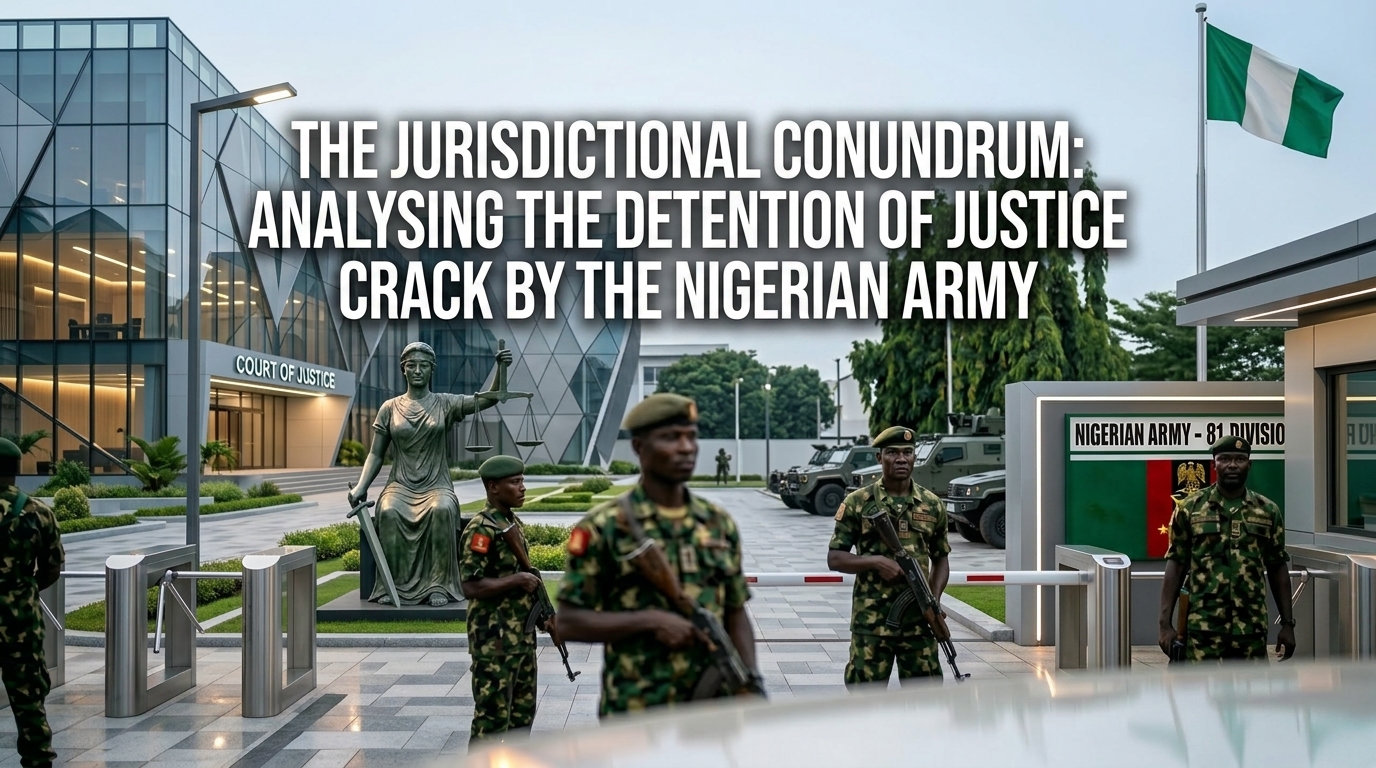
THE JURISDICTIONAL CONUNDRUM: ANALYSING THE DETENTION OF JUSTICE CRACK BY THE NIGERIAN ARMY
Abstract
The arrest and prolonged detention of Justice Mark Chidiebere, popularly known as “Justice Crack,” by the Nigerian Army in April 2026 has ignited a critical legal debate regarding military jurisdiction over civilians, the limits of free speech in the digital age, and the constitutional safeguards against arbitrary detention. This article examines the factual circumstances surrounding the detention, analyses the Nigerian Army’s legal justifications, evaluates the constitutionality of the detention under the 1999 Constitution, considers the applicability of the Armed Forces Act to civilians, and assesses the legal implications of prolonged detention. The article argues that while the Nigerian Army may have legitimate concerns regarding subversion, its detention of Justice Crack raises serious constitutional questions about military jurisdiction over civilians and the right to personal liberty.
1. INTRODUCTION
On 28 April 2026, Justice Mark Chidiebere, a prominent Abuja-based social media influencer and commentator who operates under the alias “Justice Crack,” left his home after receiving a telephone call and promptly disappeared from communication with his family. His mobile phones remained switched off, and his family and associates were unable to locate him for several days, prompting public outcry and concern.
On 2 May 2026, the Nigerian Army issued a statement confirming that Justice Crack was in its custody. The Army explained that the arrest arose from an investigation into social media posts wherein Justice Crack highlighted complaints made by soldiers regarding their feeding and general welfare conditions. According to the Army’s official statement, preliminary investigations suggested that Justice Crack was not merely reporting on welfare issues but was actively engaged in “inciting soldiers to create discontent within the system” and had chats “bordering on subversion” with the soldiers.
The Army further disclosed that Justice Crack was arrested alongside “some of the soldiers involved,” and while the soldiers remain in military custody, the influencer was transferred to “the relevant civil authorities for further investigation and possible prosecution.” The Army linked the arrest to an alleged “breach of the Armed Forces’ Social Media Policy” and attempts to “misinform the public,” while maintaining that its actions were “within legal limits” and that it “remains committed to the rule of law.”
This article critically examines the legal framework governing military detention of civilians in Nigeria, assesses the constitutionality of Justice Crack’s detention, and explores the broader implications for civil-military relations and fundamental rights protection in Nigeria’s democratic dispensation.
2. FACTUAL BACKGROUND
2.1 The Arrest and Initial Silence
Justice Crack’s disappearance on 28 April 2026 triggered immediate concern from his family. His wife reported that he had never stayed away from home without notice and that all attempts to reach him proved futile. The family’s alarm was compounded by the initial failure of any security agency to confirm his whereabouts, a situation that the Nigerian Army later addressed on 2 May 2026.
2.2 The Nigerian Army’s Statement
The Army’s statement, signed by Acting Director of Army Public Relations, Colonel Appolonia Anele, articulated three primary justifications for the arrest:
- Alleged Breach of Armed Forces’ Social Media Policy: Justice Crack was accused of violating internal military regulations governing social media conduct.
- Alleged Incitement: The Army claimed that Justice Crack “seemed to be inciting soldiers to create discontent within the system” and provided “an example was a chat bordering on subversion which Chidiebere had with the soldiers.”
- National Security Concerns: The Army argued that “a situation where civilians cultivate vulnerable personnel towards acts of subversion has far-reaching implications on discipline and national security.”
2.3 The Transfer to Civil Authorities
Importantly, the Army stated that Justice Crack “has been handed over to the relevant civil authorities for further investigation and possible prosecution,” while the soldiers involved “remain in own custody.” This distinction raises immediate questions: If the Army had legitimate jurisdiction to arrest and detain Justice Crack, why was he transferred to civil authorities? And if the transfer was necessary because military jurisdiction over civilians is limited, was the initial military detention itself lawful?
2.4 Family and Public Reaction
Justice Crack’s wife issued a public appeal: “Please Nigerian government, bring my husband back to me, back to my children. They need their father.” Human rights activist and publisher Omoyele Sowore called for Chidiebere’s release, alleging he was detained for speaking out on alleged abuses and the welfare of frontline soldiers.
3. THE CONSTITUTIONAL FRAMEWORK FOR PERSONAL LIBERTY
3.1 Section 35 of the 1999 Constitution
The cornerstone of Nigeria’s protection against arbitrary detention is Section 35 of the 1999 Constitution (as amended). This provision guarantees the right to personal liberty and strictly circumscribes the circumstances under which a person may be deprived of that liberty. The relevant portions of Section 35 provide:
“(1) Every person shall be entitled to his personal liberty and no person shall be deprived of such liberty save in the following cases and in accordance with a procedure permitted by law:
(a) in execution of the sentence or order of a court in respect of a criminal offence of which he has been found guilty;
(b) by reason of his failure to comply with the order of a court or in order to secure the fulfilment of any obligation imposed upon him by law;
(c) for the purpose of bringing him before a court in execution of the order of a court or upon reasonable suspicion of his having committed a criminal offence, or to such extent as may be reasonably necessary to prevent his committing a criminal offence…”
3.2 Procedural Safeguards Under Section 35
Section 35 further provides critical procedural safeguards for any arrested or detained person:
- Right to silence: The arrested person has the right to remain silent until after consultation with a legal practitioner.
- Right to be informed: Any person arrested or detained shall be informed in writing within twenty-four hours (and in a language he understands) of the facts and grounds for his arrest or detention.
- Right to be brought before a court: Any person arrested or detained upon reasonable suspicion of having committed a criminal offence shall be brought before a court of law within a reasonable time.
3.3 The Time Limit for Pre-Trial Detention
A constitutionally significant aspect of Section 35 is the proviso that “a person who is charged with an offence and who has been detained in lawful custody awaiting trial shall not continue to be kept in such detention for a period longer than the maximum period of imprisonment prescribed for the offence.” This provision, while aimed at preventing indefinite pre-trial detention, also underscores the constitutional expectation that detention must be promptly regularised by formal charges and court proceedings.
3.4 Application to Justice Crack’s Case
Applying Section 35 to Justice Crack’s situation, several constitutional questions emerge. First, does the initial arrest by military personnel fall within any of the permissible exceptions to personal liberty? Second, was Justice Crack informed in writing within twenty-four hours of the facts and grounds for his arrest? Third, was he brought before a court within a reasonable time? If the answer to any of these questions is negative, the detention would prima facie violate Section 35 of the Constitution.
4. MILITARY JURISDICTION OVER CIVILIANS: LEGAL PRINCIPLES
4.1 The General Rule: No Military Jurisdiction Over Civilians
It is a well-established principle of Nigerian constitutional law that the military lacks jurisdiction to arrest and detain civilians except in very limited and exceptional circumstances. The Court of Appeal has affirmed this principle in Ola v. Nigerian Army [2010] 2 NWLR (Pt. 1179) 469, where the court ruled that the Nigerian Army has no right to detain a civilian and that doing so is unconstitutional.
This principle reflects the fundamental distinction between military law, which governs service personnel, and the general criminal law, which governs civilians. As one commentator observed during the military era, even when the Constitution was suspended, courts “never hesitated to order the release of several persons whose detention was found to be patently illegal.”
4.2 The Allatchi Precedent
The locus classicus on military detention of civilians in Nigeria is Ahmed Allatchi & 243 Others v. Chief of Army Staff & 4 Others (1993). In that case, 244 persons were arrested by soldiers and policemen between October 1991 and March 1992 and detained at various military facilities without being charged to court.
The High Court of Justice of Borno State, in a ruling delivered on 2 September 1993, declared:
“I think they can’t be arrested without been told or charged to Court of Law as provided by the Constitution of the Federal Republic of Nigeria under section 34 [now Section 35]. … The applicants do not fall under any of the exceptions. I think that their arrest and detention were both illegal, null and void.”
The court ordered the immediate release of all 244 applicants and perpetually restrained the respondents from deporting them. This case remains highly relevant to Justice Crack’s situation, as it explicitly holds that the military cannot arrest and detain civilians outside the constitutional exceptions.
4.3 The Conditions for Civilian Subjection to Military Law
Despite the general rule, there are limited circumstances under which a civilian may become subject to military law. Retired Major General Yusuf Shalangwa, a former Director of Legal Services of the Nigerian Army, has explained the two conditions under which civilians can be subject to court-martial under the Armed Forces Act:
“Condition one, such a civilian must have been employed or is an employee of a military establishment, a military department or unit. … The second condition is that it must have been during war or military operation. That’s why the Armed Forces Act says it must be during active service. Active service refers to when the military is engaged in serious military operations, like the Operation HADIN KAI and you committed an act which violates any of the provisions, any of the offences provided in part 12 of the Armed Forces Act, section 45 to 114 of the Armed Forces Act, such a civilian or journalist now becomes subject to the Act and can be tried by court martial…”
4.4 Application to Justice Crack
It is evident that Justice Crack does not satisfy either condition for civilian subjection to military law. He is not an employee of any military establishment, nor was he embedded with the military on any operational tour. His alleged activities occurred entirely online, as a civilian social media commentator, not during active service in a war or military operation.
Therefore, the Armed Forces Act should not apply to Justice Crack, and the Nigerian Army lacked the legal authority to arrest or detain him. The Army’s acknowledgment that he was “handed over to civil authorities” implicitly recognises this jurisdictional limitation, but it does not retroactively validate the initial military detention.
5. THE ALLEGED OFFENCES: A LEGAL ANALYSIS
5.1 The Criminal Code Act
The Nigerian Army’s allegations against Justice Crack, incitement and subversion,find potential expression in the Criminal Code Act, which applies to civilians. The relevant provisions are:
Section 44: Inciting to Mutiny: This section provides that any person who advisedly attempts to incite any person serving in the Armed Forces of Nigeria to commit an act of mutiny or any traitorous or mutinous act is guilty of a felony and liable to imprisonment for life.
Section 45: Aiding and Inciting to Mutinous Acts or Disobedience: This section covers related acts of encouraging indiscipline among service members and carries a penalty of two years imprisonment and a fine.
5.2 The Distinction Between Advocacy and Incitement
A critical legal distinction must be drawn between legitimate advocacy (or journalism) and criminal incitement. The Nigerian Army’s initial interest in Justice Crack arose from his social media posts “highlighting complaints by soldiers over feeding and welfare.” Reporting on poor conditions within the military, amplifying soldiers’ grievances, or criticising military leadership may be unpalatable to the authorities, but it does not necessarily constitute criminal incitement.
The Army alleged that Justice Crack “seemed to be inciting soldiers to create discontent within the system” and provided an example of “a chat bordering on subversion.” However, the specific content of this “chat” has not been publicly disclosed, nor has any evidence been presented to demonstrate that Justice Crack “advisedly” attempted to incite mutiny, as required by Section 44 of the Criminal Code.
The Rule of Law and Accountability Advocacy Centre (RULAAC) has argued that discussing the welfare of security personnel is a matter of public interest and falls under the constitutional right to freedom of expression, and that raising concerns about poor conditions or amplifying grievances should not be criminalised as “subversion” without clear and verifiable evidence.
5.3 The Armed Forces’ Social Media Policy: Internal Regulation, Not Law
A significant aspect of the Army’s justification is the alleged “breach of the Armed Forces’ Social Media Policy.” This raises a fundamental question: Does an internal military policy have the force of law applicable to civilians?
The answer is clearly no. The Armed Forces’ Social Media Policy is an internal administrative regulation binding only on military personnel as part of their service conditions. A civilian cannot be bound by an internal military directive, just as a private company cannot enforce its employee handbook on a non-employee. The mention of this policy as a justification for action against a civilian is legally untenable and suggests a misunderstanding (or deliberate misapplication) of the distinction between internal regulations and public laws.
6. THE PROLONGED DETENTION: CONSTITUTIONAL AND HUMAN RIGHTS IMPLICATIONS
6.1 The Right to a Fair Hearing Within Reasonable Time
Beyond the initial legality of the arrest, the prolonged nature of Justice Crack’s detention raises separate constitutional concerns. Section 35(4) of the Constitution requires that any person arrested or detained upon reasonable suspicion of having committed a criminal offence shall be brought before a court of law within a reasonable time.
What constitutes a “reasonable time” has been the subject of judicial interpretation, but it is generally understood to mean that the detainee must be charged and brought before a court within 24 to 48 hours, or as soon as practically possible given the circumstances. Prolonged detention without charge violates this constitutional guarantee.
6.2 Incommunicado Detention and Access to Legal Representation
Justice Crack’s family reported that he was unable to communicate with them for several days after his arrest, and his phones remained switched off. This raises concerns about incommunicado detention, which is prohibited by several international human rights instruments to which Nigeria is a party, including the African Charter on Human and Peoples’ Rights.
Section 35(2) of the Constitution guarantees the right of an arrested person to consult with a legal practitioner or any other person of his own choice. If Justice Crack was denied access to his family and legal representation, this would constitute an additional constitutional violation.
6.3 The Burden of Justification on the State
In all cases of detention, the burden of proving the legality of the detention rests on the detaining authority. In Ahmed Allatchi’s case, the court noted that the respondents (military authorities) had been served and were not in court to explain why the applicants were arrested and detained, and their counter-affidavit denied arresting and detaining the applicants. The court nonetheless declared the detention illegal.
The Nigerian Army’s statement that Justice Crack “has been handed over to the relevant civil authorities” suggests that he may no longer be in military custody. However, transfer to another agency does not cure the illegality of the initial detention, nor does it eliminate the constitutional requirement that he be charged or released within a reasonable time.
7. COMPARATIVE JURISPRUDENCE: LESSONS FROM THE MILITARY ERA
The current situation bears uncomfortable similarities to past episodes in Nigeria’s history when the military detained civilians without trial. Legal historian Femi Falana (himself a former detainee under the Buhari military regime) documented how, even during the military era, courts regularly ordered the release of illegally detained persons.
Notable cases from the Buhari military regime (1984-1985) include:
- Lamina Lawal Arowoye & 6 Others v. Inspector-General of Police: The court declared the detention illegal on the grounds that the detention orders cited “acts prejudicial to public order” when the Decree required “acts prejudicial to State Security.”
- Dr. Tai Solarin v. Inspector-General of Police & 2 Ors: The court ordered the immediate release of the applicant, holding that “the respondents have failed to discharge the onus placed on them to establish the legal justification for the detention of the Applicant.”
- Maxwell Okudoh v. Commissioner of Police: Justice Oguntade (as he then was) held that the Chief of Staff could not detain for “acts prejudicial to public order” when the Decree specified other grounds, and ordered the applicant’s release.
These cases establish an important principle: even when detention is authorised by decree (let alone when it is not), courts will scrutinise the legality of detention and order release where the legal requirements are not strictly satisfied.
8. EVALUATION OF THE NIGERIAN ARMY’S POSITION
8.1 The Army’s Stated Justifications
The Nigerian Army’s position rests on several pillars:
- Jurisdiction: The Army claims the authority to arrest civilians for acts subversive to military discipline.
- Substantive Offence: Justice Crack is alleged to have committed acts bordering on subversion and incitement.
- Procedural Compliance: The Army claims to have acted “within the ambits of the law” and to have transferred Justice Crack to civil authorities.
8.2 Legal Criticisms of the Army’s Position
Each of these justifications is vulnerable to legal challenge:
On Jurisdiction: The weight of judicial authority, including Ola v. Nigerian Army and Ahmed Allatchi v. Chief of Army Staff, establishes that the military lacks jurisdiction to arrest and detain civilians outside the limited exceptions in the Armed Forces Act. Justice Crack does not fall within any of those exceptions.
On Substantive Offence: The constitutional right to freedom of expression protects political speech and commentary on matters of public interest. The line between protected speech and criminal incitement is a matter for judicial determination, not military flat. The Army’s reliance on an internal “Social Media Policy” as justification exposes the weakness of its substantive case.
On Procedural Compliance: Transferring a detainee to civil authorities does not retroactively validate military detention. If the initial arrest was unlawful, the fact of transfer does not cure the illegality. Moreover, the continued detention by civil authorities must satisfy constitutional requirements, including timely charge and court production.
9. CONCLUSION AND RECOMMENDATIONS
9.1 Summary of Findings
This analysis leads to the following conclusions:
- The Nigerian Army lacked legal jurisdiction to arrest and detain Justice Crack as a civilian, except in circumstances not present in this case. The general rule of Nigerian law is that military detention of civilians is unconstitutional.
- The Armed Forces’ Social Media Policy has no force of law over civilians and cannot justify the arrest or detention of a social media commentator.
- The prolonged detention raises serious constitutional concerns, particularly regarding Section 35 of the 1999 Constitution, which guarantees the right to personal liberty and requires timely charge and court production.
- The burden lies on the state to justify the detention, and the justifications offered to date appear legally insufficient.
- The circumstances of this case mirror historical episodes where Nigerian courts ordered the release of civilians illegally detained by the military, even during periods of military rule when fundamental rights were technically suspended.
9.2 Recommendations
Based on the foregoing analysis, the following recommendations are offered:
For the Nigerian Army:
- Clarify the legal basis for its assertion of jurisdiction over civilians in this case.
- Avoid reliance on internal policies (such as the Social Media Policy) as justifications for actions against civilians.
- Ensure that any future actions against civilians strictly comply with constitutional limitations on military jurisdiction.
For the Civil Authorities:
- If Justice Crack is in their custody, they are constitutionally obliged to either charge him with a recognisable criminal offence before a court of competent jurisdiction or release him immediately.
- The continued detention of Justice Crack without charge violates Section 35 of the Constitution.
For the Judiciary:
- Should an application for enforcement of fundamental rights be brought, the courts must assert their constitutional role as guardians of personal liberty, as they have done in previous cases such as Ahmed Allatchi and the military-era cases documented by Falana.
For Civil Society and the Legal Community:
- Create awareness on citizen’s fundamental rights.
- Advocate for clearer legislative and policy guidance on the limits of military jurisdiction over civilians in counter-terrorism and internal security operations.
For the National Assembly:
- Consider legislative action to clarify the scope of military jurisdiction over civilians, ensuring that such jurisdiction is strictly limited and subject to judicial oversight.
10. POSTSCRIPT
At the time of writing, Justice Crack remains in the custody of “relevant civil authorities” according to the Nigerian Army’s statement. His family reports that he has been unable to communicate with them. The coming days will be critical in determining whether he will be formally charged in a civilian court or released.
The case of Justice Crack is not merely about one individual. It is a test of Nigeria’s commitment to constitutionalism, the rule of law, and the protection of fundamental rights in an era of expanding security operations and securitised responses to online speech. The Nigerian courts have historically risen to the occasion when fundamental rights are threatened. Whether they will do so again remains to be seen.
REFERENCES
- Constitution of the Federal Republic of Nigeria, 1999 (as amended)
- Criminal Code Act, Cap C38, Laws of the Federation of Nigeria, 2004
- Armed Forces Act, Cap A20, Laws of the Federation of Nigeria, 2004
- Ahmed Allatchi & 243 Ors v. Chief of Army Staff & 4 Ors (1993) (Unreported) Borno State High Court
- Ola v. Nigerian Army [2010] 2 NWLR (Pt. 1179) 469
- African Charter on Human and Peoples’ Rights (Ratification and Enforcement) Act, Cap A9, Laws of the Federation of Nigeria, 2004
- Fundamental Rights (Enforcement Procedure) Rules, 2009
This article is provided for academic and informational purposes and does not constitute legal advice. Persons seeking legal redress should consult a qualified legal practitioner.
Related Articles

The Battle of the Logos: Defining the Limits of INEC’s Power in Political Party Registration

THE FEDERAL CHARACTER PRINCIPLE IN NIGERIA

Legislative Inaction and the Enforcement of Constitutional Governance in Nigeria