The Illusion of Democracy
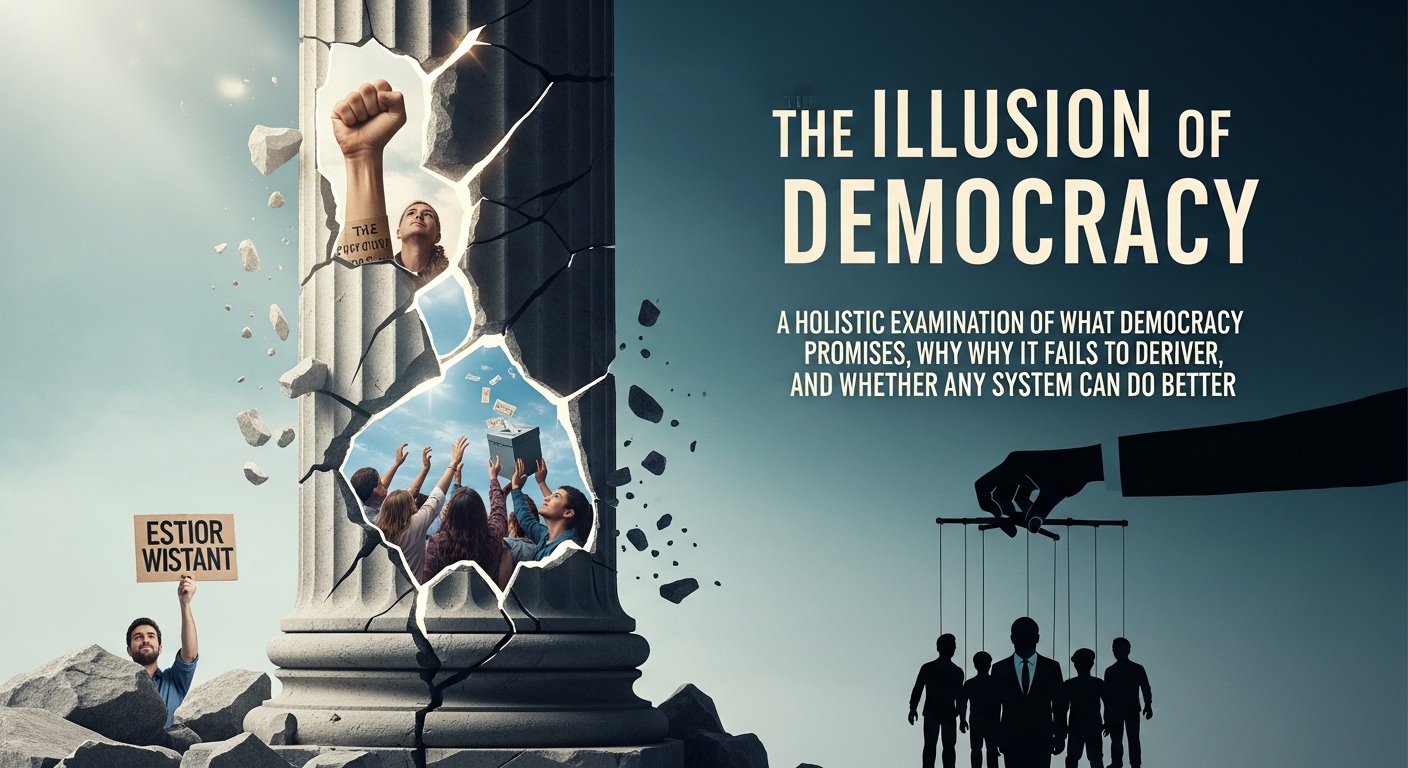
The Illusion of Democracy: A Holistic Examination of What Democracy Promises, Why It Fails to Deliver, and Whether Any System Can Do Better
Introduction: The Great Political Mirage
The word “democracy” carries immense moral weight, evoking images of citizens freely choosing their leaders and a system where every voice matters. Since the fall of the Berlin Wall, it has been presented as the only legitimate form of government, the “end of history”. Across the globe, nations proudly maintain the formal architecture of representative government, yet beneath this surface, the substance of democratic governance, accountability, popular sovereignty, and genuine political equality, is often hollowed out while the forms remain intact.
This is the illusion of democracy: a system that looks and sounds democratic yet systematically denies citizens meaningful control over the decisions that shape their lives. Democracy in its contemporary form has become a ritualized performance, a carefully maintained facade that masks the reality of rule by unelected economic elites, entrenched political dynasties, and unaccountable state apparatuses. This condition is global, manifesting as a “third wave of autocratization” characterized by gradual setbacks under a legal façade. Understanding this phenomenon requires deconstructing what democracy is supposed to be and why it fails to manifest in practice.
What Democracy Is Supposed to Be: The Theoretical Ideal
Before we can understand why democracy is illusory, we must state clearly what it promises. At its most basic, democracy means rule by the people (dēmos and kratos). Political theory identifies four core pillars that any genuine democracy must satisfy:
- Popular Sovereignty: Ultimate political authority resides in the citizenry. Leaders hold power only if delegated by the people, and policy must broadly reflect the popular will.
- Political Equality: Every citizen’s voice carries equal weight. Factors like wealth, birth, or religion cannot confer extra influence.
- Meaningful Participation: Citizens must participate continuously in deliberation and accountability, requiring access to accurate information and a free press.
- Accountability and the Rule of Law: Leaders are not above the law and can be punished for corruption or abuse of power. The legal system must apply equally to all.
Modern democracy operates as representative democracy, a compromise where citizens elect officials to govern on their behalf. The illusion of democracy begins exactly at the gap between the representative and the represented; when this gap becomes a chasm, democracy becomes a ceremonial mask over oligarchy.
Structural Engines of Illusion: Economic and Elite Capture
The most powerful engine of the democratic illusion is economic inequality. In every examined case, concentrated wealth translates into concentrated political power, violating the promise of political equality.
The United States: A Plutocratic Republic
While maintaining formal protections, the American system has increasingly become a plutocratic republic. Empirical research by Gilens and Page (2014) concluded that “the preferences of the average American have a minuscule, near-zero, statistically non-significant impact on public policy”. Instead, policy outcomes overwhelmingly reflect the preferences of economic elites.
- Real Instance: In 2017, a tax bill cutting corporate rates from 35% to 21% passed despite 65-70% of Americans opposing it. It succeeded because corporate lobbies had spent $500 million on campaign contributions and lobbying in the preceding years.
- The Wealthification of Politics: The Citizens United decision accelerated this trend, allowing 100 billionaire donors to pour a record $2.6 billion into the 2024 elections, making up nearly 20% of total spending.
Nigeria: The Godfather System and State Capture
In Nigeria, the structural illusion is more overt, manifesting as “state capture” where institutions serve the interests of a powerful few. Political parties are often “private political estates” owned by wealthy patrons who view elections as personal investments.
- Real Instance: In 2018, Ekiti State Governor Ayodele Fayose admitted that wealthy “godfathers” are the problem with Nigeria’s democracy. These individuals finance campaigns and, in return, receive contracts and public funds, leaving voters with no real say in the primary process.
This reality reaffirms Robert Michels’ “iron law of oligarchy,” which posits that all mature organizations inevitably become ruled by minorities. The technical requirements of governance create a permanent class of rulers who cannot be fully controlled by the democratic process.
The Procedural Mask: Rituals of Choice
The illusion is sustained by procedural fetishism, the belief that if elections are held and ballots are counted, the outcome must be democratic. This allows elite control to persist under the cover of formal correctness.
Managed Democracy and Illiberal States
- Russia: Russia employs “managed democracy,” where elections occur regularly, but outcomes are predetermined and genuine opposition is barred. Despite this, a 2021 poll found that 45% of Russians considered their country “fully democratic,” showing the power of procedural stagecraft.
- Hungary: Under Viktor Orbán, Hungary has become an “illiberal state” by legalistically hollowing out institutions from within. The electoral system was modified over 30 times to favor the ruling party while maintaining membership in democratic blocs like the EU.
Electoral Manipulation in the West
In the United States, the illusion of choice is maintained through gerrymandering and the Electoral College.
- Gerrymandering: In 2022, North Carolina’s map was drawn to produce 10 Republican seats and 4 Democratic seats despite a 50-50 statewide vote split.
- Electoral College: This system allows the loser of the popular vote to become president, as seen in 2016 when Hillary Clinton won by nearly 3 million votes but lost the presidency due to thin margins in three key states.
The Cognitive Layer: Why Merit Fails
A critical part of the democratic illusion is the assumption that voters act as rational, objective agents. In reality, human cognitive biases systematically produce outcomes that have little to do with merit or performance.
The Primaries Problem: Eliminating Competence Early
The best candidates rarely survive the first filter of the democratic process.
- USA 2016: In the Republican primary, Donald Trump defeated experienced governors and senators by exploiting the availability heuristic (vivid slogans like “Build the Wall”) and emotional reasoning. Voters valued “authenticity” over detailed policy knowledge.
- Nigeria 2023: Party primaries are often “outright auctions”. During the 2023 APC and PDP primaries, delegates were reportedly paid between $10,000 and $50,000 per vote. Wealth and “godfather” backing ensured Bola Tinubu’s nomination over rivals seen as more competent by civil society.
Summary of Key Cognitive Biases in Politics:
Bias | Impact on Democracy | Real-World Instance |
Confirmation Bias | Interpreting data to fit pre-existing beliefs. | In the 2020 US election, voters viewed the economy as “good” or “bad” based solely on their partisan identity. |
Availability Heuristic | Judging importance by vivid examples. | Brazilian voters in 2018 prioritized violent crime based on viral videos, even as murder rates were declining. |
Affective Bias | Voting with emotion rather than facts. | The 2016 Brexit referendum was driven by fear and anger, though few voters could cite actual immigration statistics. |
In-group/Out-group Bias | Favoring one’s own ethnic or religious group. | In Kenya’s 2017 election, over 90% of Kikuyu and Luo voters supported candidates from their own tribes, regardless of policy. |
Dunning-Kruger Effect | Low-knowledge voters overestimating their understanding. | A 2018 study found the least informed voters were the most confident and resistant to fact-checking. |
Educational and Narrative Illusions: Manufacturing Consent
Democracy relies on an informed electorate, yet civic education is often neglected, and information is systematically distorted.
The Civic Literacy Void
- Nigeria: A 2023 assessment found that only 38% of schools taught civic education regularly. Consequently, 42% of voters did not know the difference between the Senate and House of Representatives.
- United States: Only 24% of Americans could name all three branches of government in 2023, and 26% could not name any. This ignorance is weaponized by political ads that do not need to be factual because voters lack the knowledge to refute them.
Propaganda and Media Capture
Noam Chomsky’s “propaganda model” explains how democratic societies “manufacture consent” by using media to distort major issues and maintain complicity.
- The Iraq War (2003): Major US outlets repeated false administration claims about WMDs. Because the media sourced information from “official” channels, 72% of Americans believed these manufactured facts and supported the invasion.
- Media Ownership: In Nigeria, 60% of media managers have direct financial ties to political parties. During the 2022 health interview of Bola Tinubu, Channels TV reportedly edited the footage under political pressure to make the candidate appear more coherent.
- Social Media: Algorithms prioritize outrage over truth. In Brazil and India, false WhatsApp messages regarding “school sex kits” or child kidnappings have triggered lynchings and shifted elections because they exploit confirmation bias.
The Cumulative Case: Is Democracy the Best Form of Government?
When we combine structural inequality, procedural manipulation, and cognitive bias, the conclusion is that most people in self-proclaimed democracies do not actually rule. They live in “electoral oligarchies” that use democratic procedures to legitimize elite outcomes.
This leads to the uncomfortable question: Is democracy really the best form of government?
Arguments For Democracy (Even the Illusion):
- It provides a peaceful transfer of power (when it works), preventing civil war.
- It protects basic freedoms better than autocracies.
- It acts as a pressure valve, allowing for the occasional removal of the worst leaders.
Arguments Against Democracy (As Practiced):
- Competence is not selected for: Charismatic demagogues often win over skilled administrators.
- Short-termism: Leaders focus on 4-5 year election cycles, ignoring long-term crises like climate change.
- Rational Ignorance: Voters have no incentive to be informed because a single vote rarely changes an outcome.
Alternative Models to Consider:
- Epistocracy: Rule by the knowledgeable, where voting depends on passing a literacy test.
- Sortition: Selecting representatives by lottery (like a jury), eliminating the influence of money and campaigning.
- Technocracy: Decisions made by experts in relevant fields (economists, scientists).
However, no alternative has proven consistently better. History’s experiments with epistocracy led to disenfranchisement, and technocracies often devolved into brutal autocracies. Democracy is not the “best” because it produces excellence; it is arguably better because it offers accountability without violence.
Conclusion: From Illusion to Awakening
The illusion of democracy persists because it serves the powerful by providing legitimacy without accountability. But illusions cannot be sustained indefinitely. Across the world, trust in institutions is collapsing and voter apathy is rising.
Recognizing the illusion is the first step toward escaping it. To move from illusion to authentic democracy, societies would need fundamental reforms:
- Publicly funded elections to break the link between wealth and power.
- Compulsory civic and media literacy to combat cognitive manipulation.
- Proportional representation and sortition-based citizens’ assemblies to ensure genuine representation.
- Real-time fact-checking and “cooling-off” periods for political advertising.
The greatest enemy of democracy is the belief that we already have it. Only by naming the illusion of the “Democratic Mirage” can we begin the work of building a genuine democracy where power truly resides with the people.
References:
I. Foundational Theories: The Promise and the Structural Pitfalls
- Georgetown University — What is Democracy? Democracy & Governance: Establishes the core principles of popular sovereignty and political equality as the benchmarks for evaluating democratic legitimacy.
- Stanford University — What is Democracy?: Defines the role of citizens as the highest political authority, providing the standard for when procedures become empty formalities.
- Democratic Erosion — The Illusion of Democracy (2025): Invokes John Dewey’s view of democracy as a “way of life” based on collective decision-making and equitable power distribution.
- Noam Chomsky — Necessary Illusions: Thought Control in Democratic Societies (1989): Introduces the “propaganda model,” arguing that media manipulation is to democracy what the “bludgeon” is to a totalitarian state.
- Robert Michels — Iron Law of Oligarchy (1911): A seminal critique demonstrating that all mature organizations inevitably succumb to rule by an elite minority due to technical and tactical necessities.
II. The American Case Study: Plutocracy and Procedural Manipulation
- Gilens & Page — Oligarchy in the Open (2014/2025): A landmark study proving that the average American’s preferences have “near-zero” impact on policy, while economic elites exert overwhelming influence.
- Represent.Us — This study proves the U.S. isn’t a democracy: A summary of the Gilens and Page findings, detailing how Congress ignores public polling in favor of donor interests.
- Verfassungsblog — The US Supreme Court and Plutocracy: Analyzes how the dismantling of campaign finance limits (e.g., Citizens United) has turned US elections into the world’s most costly.
- LSE United States Politics and Policy — How gerrymandering could help deliver the presidency…: Examines how district map manipulation and the Electoral College violate the “one person, one vote” principle.
- Rosa-Luxemburg-Stiftung — Democracy Disregarded: Characterizes the United States as a “dollarocracy” where media moguls and billionaires wield unprecedented control.
III. The Nigerian Case Study: State Capture and Godfatherism
- Leadership.ng — Ex-LP Presidential Aspirant Warns Of Silent Hijack Of Democracy By Godfathers: Details how wealthy patrons finance campaigns to control party machinery and state resources.
- TheCable.ng — An infliction called godfatherism: Argues that elite capture of economic opportunities is the core of Nigerian political ambition.
- Punchng.com — Consequences of electoral malpractice and political godfatherism: Connects Nigeria’s stagnated development directly to a culture where leaders are “thrust into power” by wealthy benefactors.
- European Union Observation Mission (via The Peninsula): Reports that the 2023 Nigerian elections were marred by logistical failures and violence, damaging public trust in the system.
- PLACNG.org & NHRC Reports: Document disappointments regarding the failed real-time upload of results (IReV) and widespread voter intimidation and vote buying in 2023.
IV. Global Manifestations of the Illusion
- EUvsDisinfo — DISINFO: Democracy is the perfect dictatorship: Defines “managed democracy” as a system where elections occur but opposition poses no threat to the ruling party.
- The Guardian & BBC Reports on Hungary: Chronicle Viktor Orbán’s transition to an “illiberal democracy” through legalistic dismantling of the judiciary and free press.
- Cambridge Core — The Electoral Paradox (Philippines): Discusses how democratic institutions were deployed to rehabilitate the authoritarian Marcos family.
- Tricontinental — India Under Modi: Shrinking Democracy: Argues that religious nationalism is used to distract from soaring inequality and the erosion of independent institutions.
- Democratic Erosion — Ongoing Democratic Erosion in Brazil After Bolsonaro: Documents how anti-system populism led to direct attacks on the presidential palace and Supreme Court.
V. Psychology, Education, and Media Distortion
- Charles University — Examining the IRA’s Exploitation of Cognitive Biases: Analyzes how misinformation targets confirmation bias and the availability heuristic to sway voters.
- World Economic Forum — 11 cognitive biases that influence politics: Defines how internal mental shortcuts lead voters to ignore conflicting evidence.
- International IDEA — The silent infrastructure of democracy: Explains the critical link between educational attainment and genuine civic participation.
- Annenberg Public Policy Center (2023 Survey): Reveals high rates of civic ignorance in the US, with many citizens unable to name the branches of government.
- Heinrich Böll Stiftung — Testing the fault lines: Investigates how disinformation campaigns in Africa exploit social divisions to fuel distrust.
VI. Alternatives and Critical Frameworks
- Jason Brennan — Against Democracy (Georgetown University): A philosophical defense of “epistocracy,” or rule by those with demonstrated political knowledge.
- Oxford Academic & Wikipedia — Sortition: Explores the use of random selection (lottery) to create representative citizens’ assemblies.
- Anthony Downs — An Economic Theory of Democracy (1957): Proposes the theory of “rational ignorance,” explaining why voters lack incentive to be informed.
- Cato Institute & History News Network: Contextualize Churchill’s famous aphorism regarding democracy as the “worst form of government, except for all of the others”.
Related Articles
The Battle of the Logos: Defining the Limits of INEC’s Power in Political Party Registration

THE REGISTRATION OF THE NIGERIAN DEMOCRATIC CONGRESS (NDC)

Legislative Inaction and the Enforcement of Constitutional Governance in Nigeria