The Death of Democracy in Nigeria?
The Death of Democracy in Nigeria?:
From Promise to Managed Outcomes
I. The Return to Civilian Rule and the Mirage of Progress (1999–2007)
When Nigeria returned to civilian rule in 1999, the air was thick with a sense of historical rebirth. After decades of stifling military dictatorship, the transition was framed not just as a change in leadership, but as a restoration of the soul of the nation. Citizens expected a republic where power would flow from the people, where institutions would be stronger than individuals, and where the rule of law would replace the whims of a junta. The Constitution of the Federal Republic of Nigeria 1999 (as amended) became the bedrock of this hope, guaranteeing fundamental rights like the freedom of association under Section 40, which allows citizens to form political parties, and Section 221, which mandates that only these parties can canvass for votes. There was an initial, widespread optimism that the newly established Independent National Electoral Commission (INEC) would serve as a neutral referee for a thriving competitive landscape. This early era, spanning from 1999 to 2007, was defined by the restoration of civilian authority and the building of democratic institutions, yet it was also marked by structural weaknesses that began to reveal themselves immediately.
The election of Olusegun Obasanjo in 1999 marked the formal rebirth of democracy under the People’s Democratic Party, which quickly established a dominant position that bordered on a one-party system. While the structures of democracy were formally in place, the reality of political practice began to diverge from the promise as early as the 2003 elections, which were marred by irregularities. The system was producing outcomes, but its credibility was increasingly questioned as internal party democracy remained weak from its inception. The legal signals of this era were clear; cases like Onuoha v. Okafor reinforced the doctrine of party supremacy, laying the groundwork for an elite-controlled process where the choice of a candidate was considered the exclusive prerogative of a political party. This early period was an era of democratic establishment without substantive credibility, setting the stage for a managed system that would eventually hollow out the spirit of popular sovereignty.
II. The Primacy of the Party: Candidate Selection as the First Filter
The most significant distortion of Nigerian democracy does not occur on election day; it begins in the opaque corridors of party primaries. In theory, party primaries are the democratic filters meant to produce the most popular and competent representatives, but in practice, they have become the first point of democratic failure. Candidates at all tiers of government, local, state, and federal, are effectively selected by a narrow group of elites rather than elected by the party membership. The journey toward genuine electoral choice is often compromised long before the general election because internal party processes are exploited by powerful actors to shape outcomes in favor of loyalists, sidelining ordinary members. The appearance of democracy masks a process of controlled selection, reducing the official election to a mere ritual of legitimation.
The legal framework has historically provided for multiple nomination methods, including direct, indirect, or consensus primaries. However, these mechanisms are frequently manipulated by “godfathers” and party chairpersons to control outcomes. Consensus candidacy, while intended as a tool for party unity, is perhaps the most abused tool in this arsenal. Governors and party elites frequently pressure rivals to step down, engineer agreements among aspirants, and narrow the choices available to the voter. Even competitive primaries are susceptible to manipulation through the delegate system, which has effectively turned the right to represent a party into a commodity for sale. Allegations of “delegate inducement” are no longer shocking but expected, with reports indicating that large sums of money change hands in private to ensure political tickets are awarded based on financial strength rather than vision or merit.
This systemic rot is a legal reality confirmed by Nigeria’s highest courts. In the landmark case of Amaechi v. INEC (2007), the Supreme Court ruled that because the electorate votes for the party and not the candidate, Rotimi Amaechi could be declared the governor of Rivers State despite not appearing on the ballot, as he had been unlawfully substituted after winning the primary. While this ruling protected a primary winner from illegal substitution, it reinforced the deeper doctrine that party structures outweigh individual voter choice. Similarly, the case of APC v. Marafa (2019) illustrates how internal party failures can disenfranchise millions; the Supreme Court nullified all votes cast for the All Progressives Congress in Zamfara State because the party failed to conduct valid primaries. These cases reveal a system where democracy is legally defined by technical compliance and elite disputes rather than the authentic expression of the popular will.
III. The Imperial Governor and the Subversion of Grassroots Democracy
Central to the managed nature of Nigerian democracy is the figure of the state governor. In the country’s political architecture, the governor is not merely a participant; they are often the chief security officer and the undisputed leader of their party’s state machinery. This concentration of power, bolstered by Section 5 of the Constitution, allows them to exercise a layered and strategic grip on the electoral process. Governors control state party executives and local government coordinators, ensuring that any aspirant for the state assembly or local government owes their political existence to the governor’s favor. Their influence is reinforced by their command of state resources, which are often used to bankroll favored candidates while starving opposition figures of visibility and logistics.
The governor’s dominance is most absolute at the local government tier. While Section 7 of the Constitution guarantees democratically elected local governments, governors frequently bypass this by using State Independent Electoral Commissions (SIECs) to conduct local polls. These elections are almost always a “clean sweep” for the ruling party in the state, effectively killing grassroots democracy and turning the lowest tier of government into a patronage network. When dissent is attempted, it is often met with the weaponization of the security apparatus; selective enforcement and heavy deployment in opposition strongholds serve to suppress turnout and discourage participation.
The influence of governors extends far beyond their individual states. Ahead of the 2023 elections, the “G5 Governors” demonstrated how a small group of state executives could shape national trajectories through their control of party delegates and strategic withdrawal of support. This dynamic creates a political structure where loyalty flows upward to patrons rather than downward to the electorate. While there are counter-examples where public sentiment has overridden political control, such as the 2023 elections where some incumbent governors failed to secure victories for their preferred candidates, these instances remain the exception rather than the rule, typically requiring extraordinary grassroots mobilization.
IV. The Journey of the Ballot: Technology versus the Manual Legacy
If the primaries restrict the choice, the journey of the ballot from the polling unit to the final declaration often determines if that limited choice even matters. Nigeria employs a hybrid electoral system that has seen significant technological experimentation. At the polling unit, the process is often the most transparent stage: voters are accredited via the Bimodal Voter Accreditation System (BVAS), ballots are cast, and results are announced locally on Form EC8A. However, as the results begin their trek through multi-level collation centers, from ward to Local Government to state, the risk of manipulation and human error increases exponentially. Collation is inherently less transparent than voting, as it relies on fewer officials and offers greater room for human discretion and the alteration of figures.
The 2023 general elections were supposed to be a watershed moment for technological transparency with the introduction of the INEC Result Viewing Portal (IReV), which was meant to allow citizens to see scanned result sheets in real-time. Yet, the failure to upload presidential results promptly created a massive trust deficit. While INEC cited technical glitches, the public saw a familiar pattern of opacity, and confidence in the system dropped sharply. This highlighted a critical legal tension: in Nigeria, the manually collated result remains the legally decisive one. Even if electronic transmission fails or shows a different story, the paper trail managed by collation officers carries the legal weight, making technology a transparency tool rather than a legal authority.
This vulnerability is compounded by the “substantial compliance” doctrine codified in Section 134 of the Electoral Act 2022 and Section 139 of the 2026 Act. An election can only be invalidated if non-compliance with the law substantially affects the result, creating an incredibly high burden of proof for petitioners. In cases like Buhari v. Obasanjo, the court emphasized that proving irregularities across thousands of polling units is logistically overwhelming for a challenger. Consequently, democracy in Nigeria is often legally defined not as a flawless process, but as one that is “good enough” to stand, prioritizing institutional stability over the perfection of democratic expression.
V. The Judicialization of the Republic: Courts as the Final Electorate
A crucial challenge in Nigeria’s democratic system is the inconsistency and conflict among judicial decisions, particularly in the context of elections. From 1999 onward, the courts have frequently intervened to correct irregularities, but the reality has often been that conflicting rulings and delayed judgments undermine public trust. Nigeria’s democracy is now negotiated across party rooms, polling units, and courtrooms, with the real “election” often appearing unfinished until judges speak. This “judicialization” of democracy has made litigation an extension of political strategy, where outcomes can be mathematically reconstructed months after officeholders have assumed power.
The most striking example of this trend is the Uzodimma v. Ihedioha (2020) case, where the Supreme Court effectively recalculated the 2019 Imo gubernatorial results and declared Hope Uzodimma the winner despite him initially placing fourth. For many Nigerians, this case reinforced the belief that elections are concluded in courtrooms rather than at polling units. While the courts have in some instances prevented outright illegality and enforced compliance, such as in the 2019 Zamfara case, the overall pattern has created a perception of judicial unpredictability. The same procedural deviation can be treated differently depending on the court hearing the case, leaving voters uncertain about whether elections genuinely reflect their will. When citizens see that their votes can be “recalculated” by the judiciary, the moral authority of the ballot evaporates, contributing to a self-reinforcing cycle of mass apathy.
VI. The Transactional Turn: Decamping and the Erosion of Ideology
One of the most visible and disruptive features of Nigerian democracy is political “decamping” or “cross-carpeting”. Affiliate with a political party in Nigeria is rarely an expression of ideology or policy disagreement; instead, it is primarily instrumental, driven by access to power and electoral survival. Party switching has become so routine that it now defines political behavior, undermining party integrity and democratic stability. Between 2013 and 2026, Nigeria witnessed waves of defections where over several state governors, dozens of federal legislators, and hundreds of party officials defected to the All Progressives Congress (APC) from rival parties. As of early 2026, reports indicated that 29 governors were affiliated with the APC, including those who joined as recently as December 2025 to align with the federal government for access to funds and projects.
The legal framework attempts to regulate these defections through Section 68(1)(g) of the Constitution, which states that a lawmaker risks losing their seat if they leave their party unless the party merges or undergoes a significant split. Ironically, this exception has become a loophole that politicians routinely exploit, citing leadership crises or factional disputes to justify their switching without triggering a loss of office. This normalization of opportunistic decamping has profound systemic impacts: it undermines party identity, weakens accountability, and further disenfranchises voters who elect representatives based on specific party platforms. When politicians abandon the platforms that got them elected with little consequence, voter confidence declines, reinforcing the perception that loyalty is transactional rather than principled.
VII. State Coercion: The Weaponization of Enforcement Agencies
The perception of democratic decline is further fueled by allegations that government agencies have been deployed as political leverage. In a healthy democracy, agencies like the Economic and Financial Crimes Commission (EFCC), the Department of State Services (DSS), and the Police should operate independently of partisan politics. However, in Nigeria, there have been highly publicized cases where these bodies have been perceived as tools of political pressure to weaken opposition networks rather than neutral enforcers of the law.
Targeted investigations often appear to coincide with political tensions, creating incentives for actors to switch parties out of self-preservation rather than conviction. During the APC ascendancy between 2015 and 2019, critics noted that ongoing or imminent investigations sometimes disappeared entirely after a politician defected to the ruling party. This “buffer against legal pressure” reinforces the dominance of the ruling coalition and undermines institutional trust, as legal pressure becomes an expected part of political competition. When voters witness the overt political use of enforcement agencies, they often disengage, believing the entire system is rigged to benefit the powerful at the expense of the rule of law.
VIII. The Electoral Act 2026: A Final Stand for Integrity or a New Tool for Control?
In early 2026, Nigeria’s National Assembly overhauled the
country’s electoral law, producing the Electoral Act 2026. Signed by President
Bola Ahmed Tinubu, the new Act repeals the 2022 legislation and introduces
structural and technological reforms aimed at enhancing transparency. Section
47 provides for the use of technology, specifically BVAS, for voter
accreditation at polling units to reduce over-voting, though the law allows for
operational flexibility in the event of technical challenges. Section 60(3)
encourages the electronic transmission of polling unit results to the IReV
portal, with legal provisions for presiding officers who fail to comply,
although the law does not strictly make real-time transmission a condition for
election validity.
The Act also strengthens INEC’s autonomy by establishing a
dedicated INEC Fund under Section 3, requiring election resources to be made
available well in advance of elections. Political parties face new obligations:
Section 77 requires maintenance of verified digital membership registers and
submission to INEC at least 21 days before primaries. Indirect primaries are
largely curtailed, with direct or consensus primaries prioritized to reduce
elite capture. Finally, campaign spending limits were raised substantially,
allowing presidential candidates to spend up to ₦10 billion and governorship
candidates up to ₦3 billion, a measure critics warn could further favor wealthy
candidates.
Despite these reforms, civil society groups and opposition
parties have criticised aspects of the law, including continued ambiguity over
real‑time transmission and potential exploitation of technological gaps. The
Act represents both an opportunity to address structural weaknesses and a test
of political will in its implementation and enforcement.
IX. Comparative Democratic Integrity: A Global Mirror for Nigeria
A comparative analysis against other democracies highlights the depth of Nigeria’s structural weaknesses. In the United States, despite intense polarization, the decentralized nature of collation and the use of multiple independent channels ensure that no single official can easily tilt a result. In India, the world’s largest democracy, the use of biometric Electronic Voting Machines (EVMs) and simultaneous counting at the constituency level maintains high trust and reduces transmission errors. Kenya provides a more direct lesson through its Result Transmission System (RTS), which allows for real-time public viewing and has seen its courts annul elections when technological transparency standards were not met.
The United Kingdom relies on short, local collation chains with manual ballots that are highly trusted. In contrast, Nigeria’s hybrid system often combines the worst of both worlds: the delays of manual processes and the distrust caused by failing technology. While Mature democracies like India and the US rely on auditing and clear legal authority, Nigeria’s multi-tier aggregation and centralized transmission remain vulnerable to elite capture and human error.
X. Trajectory and Reform: Reclaiming the People’s Sovereignty
The history of Nigeria’s Fourth Republic shows a clear and troubling trajectory. The period from 1999 to 2007 was one of democratic establishment with overt irregularities. 2007 to 2015 saw the judicialization of democracy. 2015 to 2023 was defined by power consolidation and technological experimentation, while the current phase (2023–2026) is characterized by mass apathy, decamping, and a profound trust deficit. If these patterns hold, Nigeria risks descending into a “managed democracy” where elections occur regularly but outcomes are largely predictable within elite circles, and the substantive exercise of popular will remains limited.
To avoid the gradual death of democracy, a multi-layered reform agenda is essential. Solutions must include:
- Democratizing the Primaries: Strengthening Section 84 of the Electoral Act to mandate verifiable direct primaries with digital registers audited by INEC to end the era of selected candidates.
- Breaking the Governor’s Grip: Reforming Section 7 of the Constitution to move local government elections to INEC, stripping governors of their ability to strangulate grassroots democracy.
- Ensuring Technological Clarity: Legally mandating electronic results as the authoritative source and shortening collation layers to reduce manipulation points.
- Enforcing Anti-Defection Laws: Strengthening provisions to reduce opportunistic party-switching and mandating bye-elections for midterm defectors.
- Opening the System: Amending Section 221 to allow independent candidacy, breaking the party monopoly and introducing bottom-up competition.
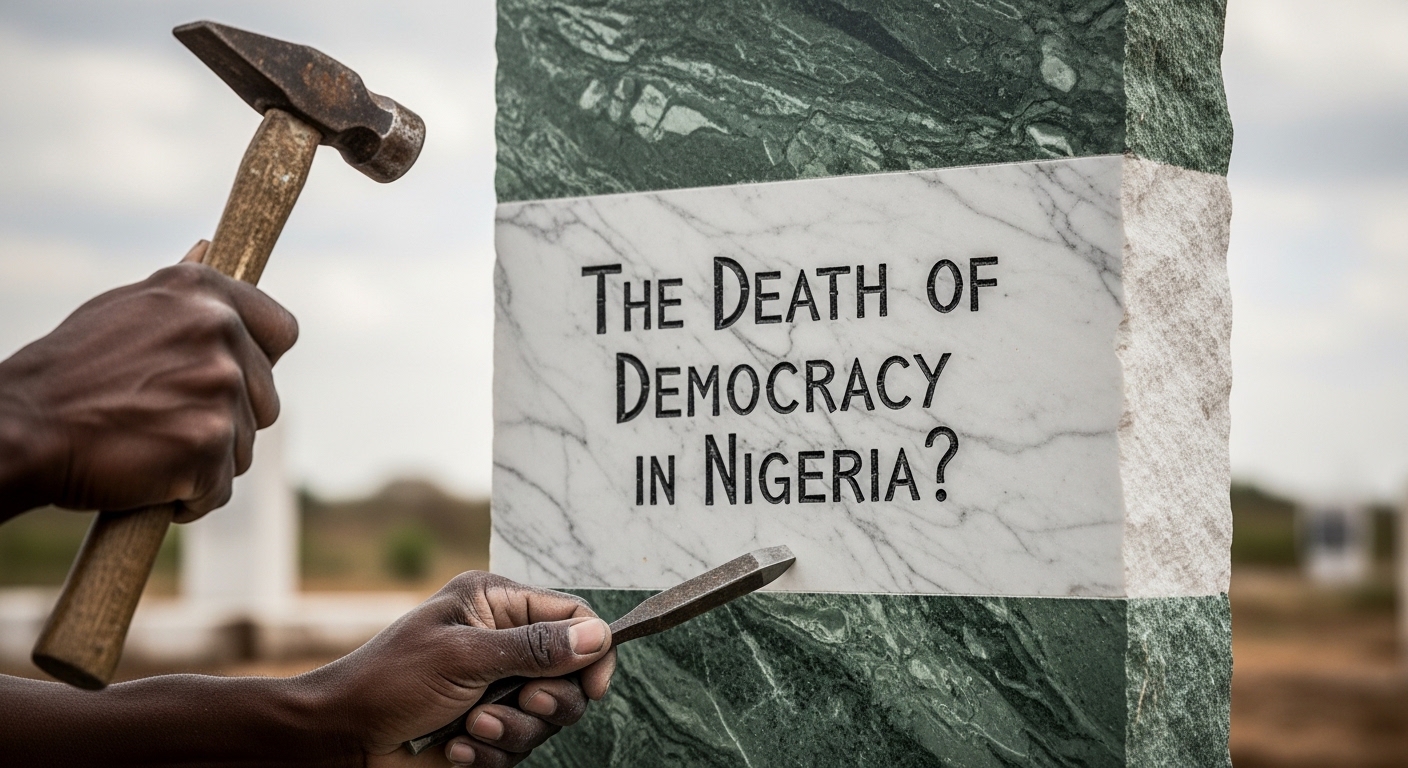
Nigeria still calls itself a democracy, but the claim grows thinner with every cycle. The system survives in form, laws are written, ballots are cast, and judges sit in robes, but the substance of popular sovereignty is in retreat. Democracy is not a gift from a political class; it is a responsibility carried by the people. Without a radical shift toward authentic participation and institutional neutrality, Nigeria risks remaining a republic in name only, while the spirit of its democracy continues to fade into the quiet dark of apathy and elite control.
References & Citations
Constitution of the Federal Republic of Nigeria 1999 (as amended)
Onuoha v. Okafor
Amaechi v. INEC (2007)
APC v. Marafa (2019)
Electoral Act 2022
Electoral Act 2026
Uzodimma v. Ihedioha (2020)
Buhari v. Obasanjo
Related Articles

The Battle of the Logos: Defining the Limits of INEC’s Power in Political Party Registration

THE REGISTRATION OF THE NIGERIAN DEMOCRATIC CONGRESS (NDC)
Legislative Inaction and the Enforcement of Constitutional Governance in Nigeria