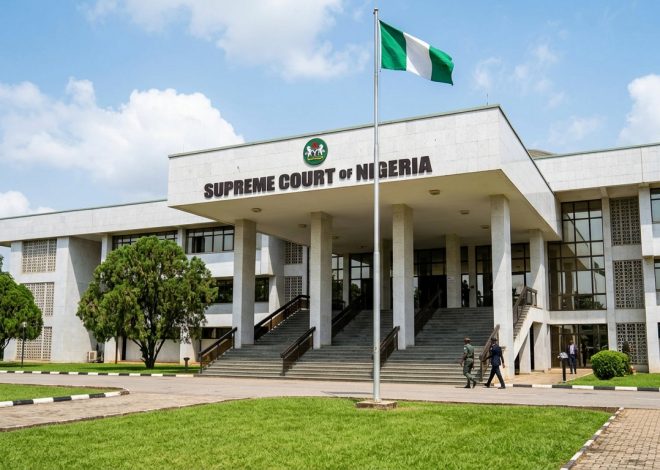
DECONSTRUCTING THE SUPREME COURT OF NIGERIA’S CONTRADICTORY RULING IN FRN V. NNAMDI KANU (2023)
THE LEGAL CORPSE THAT REFUSED TO DIE: DECONSTRUCTING THE SUPREME COURT OF NIGERIA’S CONTRADICTORY RULING IN FRN V. NNAMDI KANU (2023)
ABSTRACT
The Supreme Court of Nigeria delivered a judgment on 15 December 2023 in the case of Federal Republic of Nigeria v. Nnamdi Kanu, which has since generated intense jurisprudential controversy. The apex court acknowledged that the Terrorism (Prevention) (Amendment) Act 2013 (TPAA 2013), the statutory foundation for the prosecution, had been repealed by the Terrorism (Prevention and Prohibition) Act 2022 (TPPA 2022) more than a year before the judgment. Yet, instead of discharging the appellant, the court proceeded to remit the same charges for continued trial before the Federal High Court. This article critically examines the internal contradiction inherent in this ruling, arguing that the Supreme Court simultaneously applied two irreconcilable legal positions: recognising a repealed law as a “legal corpse” incapable of creating criminal liability while simultaneously using that same dead law to sustain prosecution. The article further explores the ruling’s implications for constitutional protections against double jeopardy, the doctrine of finality of appellate discharge, the principle of per incuriam, and Nigeria’s obligations under international law. It concludes that the judgment represents a dangerous precedent that undermines the rule of law and fundamental rights protections in Nigeria’s criminal justice system.
1. INTRODUCTION
The relationship between judicial finality and constitutional supremacy lies at the heart of every functioning democracy. When a nation’s highest court issues a ruling, particularly one that touches upon fundamental rights and the very foundation of criminal liability, that ruling must not only be final but must also be coherent, legally sound, and faithful to constitutional imperatives. The Supreme Court of Nigeria’s judgment in Federal Republic of Nigeria v. Nnamdi Kanu (Appeal No. SC/CR/1361/2022) has been described by critics as achieving neither finality in the service of justice nor coherence in the application of law.
Nnamdi Kanu, the leader of the Indigenous People of Biafra (IPOB), had been discharged and acquitted by the Court of Appeal on 13 October 2022. The appellate court held that the Federal Government’s extraordinary rendition of Kanu from Kenya, effected without extradition proceedings and in breach of domestic and international law, had vitiated the trial court’s jurisdiction, rendering the entire prosecution incompetent and unlawful. The Federal Government appealed to the Supreme Court.
On 15 December 2023, a five-member panel of the Supreme Court delivered a unanimous judgment that reversed the Court of Appeal’s decision and remitted the case to the Federal High Court for continued prosecution. The apex court acknowledged that the Federal Government had acted “irresponsibly” in forcefully bringing Kanu back to Nigeria from Kenya, but held that this illegality was insufficient to divest the trial court of its jurisdiction. The court further instructed that Kanu’s remedy lay in a separate civil action for damages, a holding that critics argue effectively rewarded state illegality.
However, the most legally problematic aspect of the Supreme Court’s ruling concerns the status of the Terrorism (Prevention) (Amendment) Act 2013. The court acknowledged that this law had been repealed by the TPPA 2022, yet proceeded to remit the same charges, all of which had been predicated on the repealed statute, for trial before the Federal High Court. This article argues that the judgment contains an internal contradiction so fundamental that it renders the ruling per incuriam and void ab initio.
2. BACKGROUND TO THE PROSECUTION
2.1 The Statutory Framework
Nnamdi Kanu was initially charged before the Federal High Court, Abuja, on 15 counts bordering on treasonable felony, terrorism, and unlawful possession of firearms. The terrorism-related counts were predicated on broadcast materials he allegedly made between 2018 and 2021 from locations outside Nigeria, primarily from Britain and Kenya. The legal foundation for these charges was the Terrorism (Prevention) (Amendment) Act 2013 (TPAA 2013). This statute granted the Federal High Court extraterritorial jurisdiction without requiring double criminality, meaning jurisdiction attached regardless of whether the alleged acts constituted criminal offences in the countries where they were physically performed.
2.2 The Repeal by the TPPA 2022
On 12 May 2022, the National Assembly enacted the Terrorism (Prevention and Prohibition) Act 2022 (TPPA 2022). Section 104 of the TPPA 2022 expressly repealed the TPAA 2013 in its entirety. The new Act introduced a significant jurisdictional safeguard: a double criminality test under Section 76(1)(d)(iii). Under this provision, the Federal High Court could exercise extraterritorial jurisdiction over an alleged offence only if the act also “constitute[d] an offence under the law of the foreign state” where the act was performed.
Crucially, the TPPA 2022 contained “savings clauses” in Sections 97 and 98, which purported to preserve liabilities incurred, investigations commenced, and legal proceedings ongoing under the repealed Act. These provisions became central to the legal controversy surrounding the continued prosecution.
2.3 The Court of Appeal’s Discharge (13 October 2022)
Approximately five months after the repeal of the TPAA 2013, and before the Supreme Court’s December 2023 intervention, the Court of Appeal delivered a landmark judgment discharging Kanu. The appellate court held that the Federal Government’s forceful rendition of Kanu from Kenya breached “all known local and international laws,” rendering the terrorism charges “incompetent and unlawful”. The court ordered his immediate release, effectively terminating all pending charges.
It was against this factual and legal backdrop that the Federal Government appealed to the Supreme Court. By the time the apex court heard the appeal, the TPAA 2013 had been repealed for over eighteen months.
3. THE SUPREME COURT’S HOLDING: A STUDY IN CONTRADICTION
The Supreme Court’s ruling, delivered by Justice Garba Mohammed and read by Justice Emmanuel Agim, can be analysed along two parallel legal axes. On one axis, the court addressed the question of jurisdiction following illegal rendition. On the other axis, it addressed the question of whether prosecution could continue under a repealed statute. It is the court’s handling of the second question that has generated the most sustained criticism.
3.1 The Court’s Acknowledgment of the Repeal
Critically, the Supreme Court did not ignore the repeal of the TPAA 2013. Rather, the court proceeded from the premise that the repealed law was indeed dead. Counsel for Kanu’s defence team, Barrister Njoku Jude Njoku, alleged that the Supreme Court “knowingly resurrected a dead law”, the Terrorism (Prevention) (Amendment) Act 2013, which had been repealed more than a year before the judgment. According to Njoku:
“The Supreme Court did not merely overlook the repeal, it affirmatively misrepresented a dead law as alive. This was not ignorance. It was judicial falsehood with consequential oppression.”
The internal contradiction becomes apparent when one examines the court’s reasoning. The Supreme Court has held, in a long line of authorities including AG Lagos State v. Dosunmu (1989), that a repealed law ceases to exist in the eyes of the law: “No right, no liability, and no trial can be founded on a repealed statute unless expressly preserved by a savings clause.” In Uwaifo v. Attorney-General of Bendel State, the Supreme Court held that “a repealed statute cannot confer jurisdiction. Any proceeding conducted under a repealed law is a nullity.”
Yet, despite acknowledging the repeal in principle, the Supreme Court did not discharge Kanu. Instead, it remitted the same charges, all predicated on the repealed TPAA 2013, to the Federal High Court for continued prosecution.
3.2 The Two Irreconcilable Positions
The judgment thus contains two mutually exclusive legal positions applied simultaneously:
Legal Position |
Statement Adopted by Court |
Consequence |
|---|---|---|
Position A |
The TPAA 2013 has been repealed. A repealed law is a “legal corpse” that cannot create criminal liability. |
Kanu must be discharged on all terrorism-related counts. |
Position B |
The charges predicated on the TPAA 2013 ought to be remitted for trial before the Federal High Court. |
Kanu must face continued prosecution under the repealed law. |
As Njoku described it: “The Supreme Court applied two contradictory legal positions in one ruling, admitting that a repealed law cannot sustain a charge, and still remitting the same repealed-law charge for trial. This contradiction voids the judgment ab initio.”
3.3 The Court’s Reliance on “Savings Clauses”
The legal basis for Position B appears to have been the savings clauses in Sections 97 and 98 of the TPPA 2022. Sections 97 and 98 preserved liabilities incurred, investigations commenced, and legal proceedings ongoing under the repealed TPAA 2013. The Supreme Court likely reasoned that because Kanu’s trial had commenced before the repeal, the savings clauses authorised its continuation under the framework of the old law.
However, this reasoning suffers from a fatal flaw. By the time the Supreme Court delivered its judgment on 15 December 2023, there was no “pending proceeding” to preserve. The Court of Appeal had discharged Kanu and acquitted him on 13 October 2022, more than fourteen months before the Supreme Court’s ruling. As the Mazi Nnamdi Kanu Global Defence Consortium argued:
“Savings clauses preserve pending matters. They do not create new proceedings. They do not override the Constitution. They do not resurrect repealed laws. After the Court of Appeal’s 13 October 2022 discharge, there was no ‘pending’ proceeding to save. What followed in 2023 was a new trial, which cannot be rooted in a repealed law.”
The attempt to use transitional provisions as a “resurrection tool” is legally impermissible because a trial that has been terminated by a final appellate discharge cannot be revived by a savings clause designed only for pending proceedings.
4. THE CONSTITUTIONAL CONFLICT: VIOLATIONS OF FUNDAMENTAL RIGHTS
The Supreme Court’s contradictory ruling implicates multiple constitutional protections enshrined in the 1999 Constitution of the Federal Republic of Nigeria (as amended).
4.1 Section 36(9) and the Prohibition of Double Jeopardy
Section 36(9) of the 1999 Constitution provides:
“No person who shows that he has been tried by any court of competent jurisdiction or tribunal for a criminal offence and either convicted or acquitted shall again be tried for that offence or for a criminal offence having the same ingredients as that offence save upon the order of a superior court.”
This provision incorporates the common law pleas of autrefois acquit (previously acquitted) and autrefois convict (previously convicted) into Nigeria’s constitutional framework. The protection is not merely statutory but constitutional and non-derogable.
The Supreme Court’s judgment is arguably incompatible with Section 36(9) on two grounds. First, the Court of Appeal had effectively acquitted Kanu on 13 October 2022, triggering the constitutional shield against retrial for the same offences. Second, by remitting the case for trial on the same counts, the Supreme Court stripped Kanu of this protection.
Barrister Onyedikachi Ifedi, a member of Kanu’s legal team, characterised the ruling as a betrayal of constitutional protections:
“We condemn in the strongest possible terms the Supreme Court of Nigeria’s grotesque betrayal of the Constitution in FRN v. Nnamdi Kanu. By overturning a lawful discharge grounded in state-sponsored kidnapping, the Court has illegally derogated from non-derogable Chapter IV rights, annulled the constitutional prohibition against double jeopardy, and reduced Nigeria’s judiciary to an arm of executive lawlessness.”
The petition filed by the Global Defence Consortium before the Chief Justice of Nigeria similarly argued that the ruling violated “the constitutional prohibition of autrefois acquit,” citing FRN v. Ifegwu (2003) 15 NWLR (Pt. 842) 113 SC, where the Supreme Court itself held that the protection against double jeopardy is absolute.
4.2 Section 36(12): The Requirement of a Law “In Force”
Section 36(12) of the 1999 Constitution provides that no person shall be convicted of a criminal offence unless that offence is defined and the penalty therefor is prescribed in a written law. By necessary implication, a law that has been repealed ceases to be “in force” and cannot support a criminal trial or conviction.
As Njoku argued:
“On 20 November 2025, the 2013 Act was not in force. It is legally impossible to convict anyone under it. This alone renders the judgment a nullity.”
The Supreme Court’s December 2023 ruling, which remitted charges under a law that had ceased to exist, functions as a judicial instruction to lower courts to proceed on a basis that the Constitution explicitly prohibits. A trial conducted under a repealed law is not merely irregular; it is void ab initio.
4.3 Section 1(3): The Supremacy of the Constitution
Section 1(3) of the 1999 Constitution provides that any law inconsistent with the Constitution shall be void to the extent of the inconsistency. The Supreme Court’s ruling arguably violates this provision by subordinating constitutional protections (including the right against double jeopardy and the requirement of a law in force) to statutory considerations under the Terrorism Prevention Act.
The consortium’s petition to the Chief Justice of Nigeria stated:
“By subordinating Section 36 CFRN (fair hearing) to statutory jurisdiction under the Terrorism Prevention Act and Section 251 CFRN, Your Lordships inverted this hierarchy. The Constitution does not bend to statutes.”
5. JURISPRUDENTIAL CRITIQUE: WHY THE RULING CANNOT STAND
5.1 The Principle: A Repealed Law is a “Legal Corpse”
The Supreme Court has repeatedly and consistently held that a repealed law is devoid of legal effect. In AG Lagos State v. Dosunmu (1989), the court stressed that when a statute is repealed, “it is as if it never existed”. In Uwaifo v. Attorney-General of Bendel State, the court held unequivocally that “a repealed statute cannot confer jurisdiction”. In Okenwa v. Military Governor of Imo State, Akinyede v. The Appraiser, Aoko v. Fagbemi, and other authorities, the same principle was affirmed.
These authorities establish what the defence consortium called “black-letter law”: a repealed law is dead, extinct, and of no legal effect. It cannot be the foundation of a charge, trial, or conviction.
5.2 The Exception: Savings Clauses Cannot Create New Trials
The TPPA 2022 contains savings clauses in Sections 97 and 98, which preserve liabilities incurred and proceedings commenced under the repealed TPAA 2013. The Supreme Court likely relied on these provisions to justify remitting the case for continued prosecution.
However, the defence consortium argued, persuasively, that savings clauses preserve pending matters only. They do not create new proceedings. They do not resurrect repealed laws. They cannot override the Constitution. After the Court of Appeal’s discharge on 13 October 2022, there was no “pending proceeding” to preserve. What followed in 2023, after the Supreme Court’s intervention, was effectively a new trial, which cannot be rooted in a repealed law.
Moreover, the question arises: can a savings clause in a statute validly override a constitutional protection? The answer, under Section 1(3) of the Constitution, is clearly no. A legislative savings clause cannot confer jurisdiction on a court to prosecute an individual in violation of Section 36(9) (double jeopardy) or Section 36(12) (requirement of a law in force). To the extent that Sections 97 or 98 of the TPPA 2022 purport to authorise such a prosecution, they are void for constitutional inconsistency.
5.3 The Ruling as Per Incuriam
A judgment is said to have been delivered per incuriam, literally, “through lack of care”, when it was decided without reference to a relevant statute or binding precedent that would have compelled a different outcome. The Supreme Court has held that a decision can be given per incuriam when it was “wrongly decided based on a failure to consider binding precedent or statute”. A court has the inherent power to refuse to be bound by its own per incuriam decisions.
The December 2023 ruling in FRN v. Nnamdi Kanu arguably meets the criteria for a per incuriam judgment. The Supreme Court ignored or failed to give proper effect to its own binding precedents in Dosunmu, Uwaifo, and Ifegwu. It failed to take judicial notice of the repeal of the TPAA 2013, despite Section 122 of the Evidence Act 2011, which mandates all courts to take judicial notice of repealed or newly enacted laws. And it violated Section 36(9) of the Constitution without acknowledging the conflict.
Njoku argued before the Chief Justice of Nigeria that the ruling “threatens not only one man but the very foundations of Nigeria’s constitutional democracy” and that “no doctrine of finality can shield a nullity”. If the Supreme Court’s December 2023 ruling is indeed per incuriam, the Supreme Court retains the inherent power to correct its own record.
5.4 The Doctrine of Finality of Appellate Discharge
The doctrine of finality of appellate discharge holds that once an appellate court has discharged an accused person, the prosecution is extinguished at its root, and jurisdiction to retry the accused for the same offences is permanently lost. This doctrine is recognised across common law jurisdictions, including in England (R v. Pinfold [1843] 5 Man & G 463, R v. Green [1950] 1 All ER 786) and Canada (R v. Riddle).
Njoku argued before the Supreme Court that:
“Once the Court of Appeal pronounced discharge, Mazi Nnamdi Kanu became constitutionally untouchable for the same offences, the prosecution was extinguished at its root, and jurisdiction to retry him permanently lost.” He cited FRN v. Ifegwu (2003) 15 NWLR (Pt 842) 113 at 175 and Abacha v. Fawehinmi (2000) 6 NWLR (Pt 660) 228 in support.
Chief Justice Garba Lawal’s panel, by remitting the case after an appellate discharge, set aside this doctrine of finality and effectively rewrote the constitutional protections available to all accused persons in Nigeria. As Ifedi put it: “The Court’s invented ‘national security’ exception is a fraudulent rewrite of the supreme law.”
6. THE PRINCIPLE OF EX INJURIA JUS NON ORITUR
Beyond the domestic constitutional framework, the Supreme Court’s ruling also conflicts with a foundational principle of international law: ex injuria jus non oritur, “law does not arise from injustice.” This principle holds that illegal acts cannot create legal rights or legal consequences favourable to the wrongdoer.
The Court of Appeal’s October 2022 judgment had emphasised that the Federal Government’s extraordinary rendition of Kanu from Kenya, effected without judicial authorisation and in breach of the Extradition Act, violated both Nigerian domestic law and international law obligations. By holding that this illegality did not divest the trial court of jurisdiction, the Supreme Court arguably violated the ex injuria principle. As Barrister Ifedi argued:
“The Court of Appeal’s discharge order was a final acquittal, yet the Supreme Court resurrected dead charges in service of state impunity.” Citing the UK case R v. Horseferry Road Magistrates’ Court (a landmark decision on abuse of process arising from illegal rendition), Ifedi maintained that prosecutions arising from unlawful rendition lack jurisdiction and should be nullified.
The principle is particularly important in cases involving trans-border abductions. Courts in the United Kingdom, the European Court of Human Rights, South Africa, and other jurisdictions have consistently held that when an accused person is brought within a state’s jurisdiction through flagrant illegality, including unlawful rendition or abduction, the courts may decline jurisdiction as an abuse of process. The Supreme Court’s contrary holding in Kanu’s case places Nigeria at odds with this international consensus.
7. VIOLATION OF INTERNATIONAL HUMAN RIGHTS OBLIGATIONS
Nigeria is a state party to the International Covenant on Civil and Political Rights (ICCPR) and the African Charter on Human and Peoples’ Rights (ACHPR). Both instruments contain provisions protecting individuals against double jeopardy and guaranteeing fair hearing rights.
Article 14(7) of the ICCPR provides that no person shall be liable to be tried or punished again for an offence for which they have already been finally convicted or acquitted. Article 7 of the ACHPR guarantees the right to a fair hearing, including the right not to be tried again for an offence for which one has already been acquitted. The African Charter has been domesticated in Nigeria through the African Charter on Human and Peoples’ Rights (Ratification and Enforcement) Act, making it enforceable in Nigerian courts.
Kanu himself invoked Articles 7 and 26 of the African Charter in challenging his prosecution under the repealed TPAA 2013. The Supreme Court’s ruling, by disregarding the Charter’s protections, arguably placed the Nigerian judiciary in violation of the country’s international legal obligations. As Ifedi noted:
“The ruling violates Nigeria’s obligations under the International Covenant on Civil and Political Rights (ICCPR) and the African Charter on Human and Peoples’ Rights, describing it as ‘morally perverse’ and ‘internationally shameful.'”
The African Commission on Human and Peoples’ Rights has previously held that member states are obliged to respect the finality of judicial decisions and may not relitigate matters that have been finally determined by competent courts. The Supreme Court’s remittal of Kanu’s case after an appellate discharge arguably falls short of Nigeria’s obligations under the Charter.
8. BROADER IMPLICATIONS FOR THE NIGERIAN LEGAL SYSTEM
The contradictory ruling in FRN v. Nnamdi Kanu has implications that extend far beyond the fate of a single accused person. Several consequences merit attention.
8.1 Erosion of Public Confidence in the Judiciary
Public confidence in the judiciary is a cornerstone of the rule of law. If the highest court can issue a ruling that acknowledges a repealed law as dead yet simultaneously uses that law to sustain prosecution, the public will reasonably conclude that judicial outcomes are determined not by law but by expediency. A rights lawyer commented: “This ruling erodes public confidence in Nigeria’s judicial system and its adherence to due process.”
8.2 Encouragement of Prosecutorial Abuse
If the state can continue prosecuting an individual under a repealed law after an appellate discharge, there is little to prevent prosecutorial abuse in less politically charged cases. The Okwu-Kanu family warned: “The NBA’s inaction ‘normalises abuses,’ empowers ‘judges who ignore clear legal limits,’ and sends the message that Nigerian lawyers have abandoned their responsibility to uphold the law.”
8.3 Instability of Criminal Jurisprudence
The Supreme Court’s December 2023 ruling creates uncertainty in Nigerian criminal jurisprudence. If a repealed law can be resuscitated through judicial fiat and savings clauses, then no criminal statute is ever truly repealed. Defence counsel cannot advise clients on the applicable law with confidence if courts may disregard clear legislative repeals. The principle of legality, nullum crimen, nulla poena sine lege (no crime, no punishment without law), is undermined.
8.4 Impact on Future Appeals
The Global Defence Consortium has announced its intention to appeal the ruling and has described the conviction that followed as “legally impossible”. The consortium predicted that “higher courts are expected to overturn Kanu’s conviction because the law under which he was convicted was repealed three years ago and cannot legally sustain a trial or conviction.”
9. COMPARATIVE PERSPECTIVES
A comparative analysis reveals that the Nigerian Supreme Court’s approach in Kanu’s case diverges significantly from the jurisprudence of other common law jurisdictions on similar issues.
9.1 England: The Abuse of Process Doctrine
In R v. Horseferry Road Magistrates’ Court, ex parte Bennett [1994] 1 AC 42, the House of Lords held that where a defendant had been brought within the jurisdiction by unlawful abduction, the trial court had jurisdiction to stay the prosecution as an abuse of process. The court reasoned that to do otherwise would be to condone state illegality. The Nigerian Supreme Court’s contrary holding, that the illegality of Kanu’s rendition did not divest jurisdiction, places Nigeria at odds with this approach.
9.2 Double Jeopardy in Comparative Context
The strictness of Nigeria’s double jeopardy protection under Section 36(9) is comparable to the common law position in Canada and the United States. However, the United Kingdom enacted the Criminal Justice Act 2003, which modified the double jeopardy rule by allowing retrials if “new and compelling evidence” emerges after an acquittal or if the original acquittal was tainted by fraud or perjury. Even under the more flexible UK approach, the Supreme Court’s remittal of Kanu’s case in the absence of new evidence or fraud would not be permissible.
The Nigerian provision remains absolute and unqualified, subject only to the exception of an order of a superior court. The Supreme Court’s remittal may have purported to fall within this exception, but constitutional scholars argue that an order of a superior court cannot override the constitutional right itself. The exception permits an order for retrial in limited circumstances, such as where the original trial was a nullity, but does not permit the court to disregard the constitutional protection altogether.
9.3 International Law on Unlawful Rendition
The United Nations Human Rights Council and treaty monitoring bodies have consistently held that trials conducted after unlawful rendition or abduction may violate the right to a fair trial under Article 14 of the ICCPR. The UN Special Rapporteur on the promotion of truth, justice, reparation and guarantees of non-recurrence has documented how unlawful cross-border abductions undermine the integrity of judicial proceedings. The Supreme Court’s validation of Kanu’s continued prosecution, despite acknowledging that the government acted “irresponsibly” in his abduction, places Nigeria on the wrong side of this international consensus.
10. CONCLUSION
The Supreme Court of Nigeria’s judgment in Federal Republic of Nigeria v. Nnamdi Kanu (Appeal No. SC/CR/1361/2022) is internally contradictory in a manner that strikes at the foundations of criminal jurisprudence and constitutional protection. The court acknowledged that the Terrorism (Prevention) (Amendment) Act 2013 had been repealed, a legal corpse incapable of sustaining criminal liability, yet proceeded to remit the same charges for trial under that very law.
This contradiction is not a minor inconsistency. It is fundamental to the outcome of the case. If the TPAA 2013 was indeed a dead law, the terrorism counts predicated on it should have been struck out. If the court intended to rely on the savings clauses in the TPPA 2022 to preserve the prosecution, it should have acknowledged that the trial was being continued under the framework of the new law, which includes the double criminality test under Section 76, rather than permitting a de facto prosecution under a repealed statute. The court did neither, leaving a judgment that is logically incoherent and legally unsustainable.
Beyond the internal contradiction, the ruling violates multiple constitutional protections: Section 36(9) (protection against double jeopardy), Section 36(12) (the requirement of a law in force), and Section 1(3) (constitutional supremacy). It disregards the doctrine of finality of appellate discharge, conflicts with the principle of ex injuria jus non oritur, and arguably violates Nigeria’s obligations under the ICCPR and the African Charter.
The Supreme Court retains the inherent power to revisit and correct its own per incuriam judgments. The Global Defence Consortium has petitioned the Chief Justice of Nigeria to do exactly that. Whether the court will exercise that power remains to be seen. But irrespective of the ultimate disposition of Kanu’s case, the December 2023 judgment stands as a warning: when a nation’s highest court issues a ruling that is internally contradictory and constitutionally infirm, it is not only the rights of a single accused that are at risk, it is the entire architecture of constitutional governance.
As Barrister Njoku Jude Njoku concluded:
“If the judgment is allowed to stand, dead laws can be revived to prosecute citizens, double jeopardy will lose its meaning, and courts will become co-agents of government reprisal.”
The ultimate question for the Nigerian judiciary is whether it will reaffirm its commitment to constitutional supremacy and the rule of law, or whether it will permit the December 2023 ruling to stand as a precedent that undermines both.
11. REFERENCES
11.1 Primary Sources (Nigerian Legislation)
- Constitution of the Federal Republic of Nigeria, 1999 (as amended).
- Terrorism (Prevention) (Amendment) Act, 2013 (repealed).
- Terrorism (Prevention and Prohibition) Act, 2022.
- Evidence Act, 2011.
- African Charter on Human and Peoples’ Rights (Ratification and Enforcement) Act, Cap. A9, Laws of the Federation of Nigeria, 2004.
11.2 Primary Sources (International Instruments)
- International Covenant on Civil and Political Rights (ICCPR), adopted 16 December 1966, entered into force 23 March 1976.
- African Charter on Human and Peoples’ Rights, adopted 27 June 1981, entered into force 21 October 1986.
11.3 Nigerian Case Law
- AG Lagos State v. Dosunmu (1989).
- Uwaifo v. Attorney-General of Bendel State.
- FRN v. Ifegwu (2003) 15 NWLR (Pt 842) 113.
- Abacha v. Fawehinmi (2000) 6 NWLR (Pt 660) 228.
- Okenwa v. Military Governor of Imo State.
- Akinyede v. The Appraiser.
- Aoko v. Fagbemi.
- Ogugu v. State (1994) 9 NWLR (Pt. 366) 1 SC.
- ELEBANJO V. DAWODU (Supreme Court, on definition of per incuriam).
- Federal Republic of Nigeria v. Nnamdi Kanu, Appeal No. SC/CR/1361/2022 (Supreme Court, 15 December 2023).
- Federal Republic of Nigeria v. Nnamdi Kanu, Appeal No. CA/ABJ/CR/625/2022 (Court of Appeal, 13 October 2022).
11.4 International and Comparative Case Law
- R v. Horseferry Road Magistrates’ Court, ex parte Bennett [1994] 1 AC 42 (House of Lords).
- R v. Pinfold [1843] 5 Man & G 463 (England).
- R v. Green [1950] 1 All ER 786 (England).
- Adegbenro v. Akintola (1963) 1 WLR 797 (Privy Council).
- R v. Riddle (Canada).
11.5 Secondary Sources (Articles and Commentary)
- Ezeh, E.O. & Amasiatu, I. “Analysis of the Principles Guiding the Applicability of the Rule Against Double Jeopardy in Nigeria.” International Journal of Law and Clinical Legal Education, 2026. DOI: 10.2307/ijolacle.2026.4378.
- Al-Mujahid, A.A. “The Concept of Double Jeopardy in Nigerian Law.” Law Global Hub, 2025.
- Oluwaleye, A.G. “Double Jeopardy in Nigeria: Justice Secured or Justice Denied? Examining the Balance Between Finality and Truth in Nigeria’s Criminal Justice System.” Opinion Nigeria, 2025.
- Global Defence Consortium. “Petition to the Chief Justice of Nigeria Regarding Supreme Court Judgment in FRN v. Nnamdi Kanu,” September 2025.
11.6 News Media Reports (as cited in footnotes)
- “Supreme Court Overturns A’Court Judgement on Nnamdi Kanu, Insists He Must Face Trial.” Time Africa Magazine, 15 December 2023.
- “Nnamdi Kanu Approaches Supreme Court To Battle ‘Judgment That Destroyed Justice’.” Independent Newspaper Nigeria, 11 November 2025.
- “Why We Blocked Kanu’s Trial When I Was Lead Counsel.” The Source, 29 November 2025.
- “Why Nnamdi Kanu’s conviction cannot survive appeal – Defence team.” Daily Post, 1 December 2025.
- “Supreme Court wrong to remit case after Nnamdi Kanu’s acquittal by Court of Appeal – Lawyer.” Daily Post, 30 October 2025.
- “Lawyer of IPOB leader, Kanu, accuses Supreme Court of ‘betraying the constitution’.” Ripples Nigeria, 8 August 2025.
- “Kanu’s Lawyer Faults S’Court Judgment, Says ‘Constitution Downgraded To Expediency’.” Independent Newspaper Nigeria, 26 September 2025.
- “Nigerian Bar Association By Its Silence Enabling Unlawful Trial Of Nnamdi Kanu – Okwu-Kanu Family.” Sahara Reporters, 14 November 2025.
- “Why Justice Omotosho tried, convicted Nnamdi Kanu under a law ‘that no longer exists’.” PM News Nigeria, 22 November 2025.
- “Kanu: Reasons judgment can’t stand, by lawyers.” The Sun Nigeria, 22 January 2026.
- “Lawyer Faults Supreme Court Judgment On Nnamdi Kanu.” The Whistler, 17 September 2025.
- “Kanu’s conviction a Per Incuriam verdict, Lawyer.” Vanguard, 23 November 2025.
The author acknowledges the legal scholarship of Barristers Njoku Jude Njoku, Onyedikachi Ifedi, Aloy Ejimakor, and Christopher Chidera, whose critiques of the Supreme Court’s judgment informed this analysis.
Related Articles

Conflicting Supreme Court Judgments in Nigeria: Anatomy of a Judicial Crisis