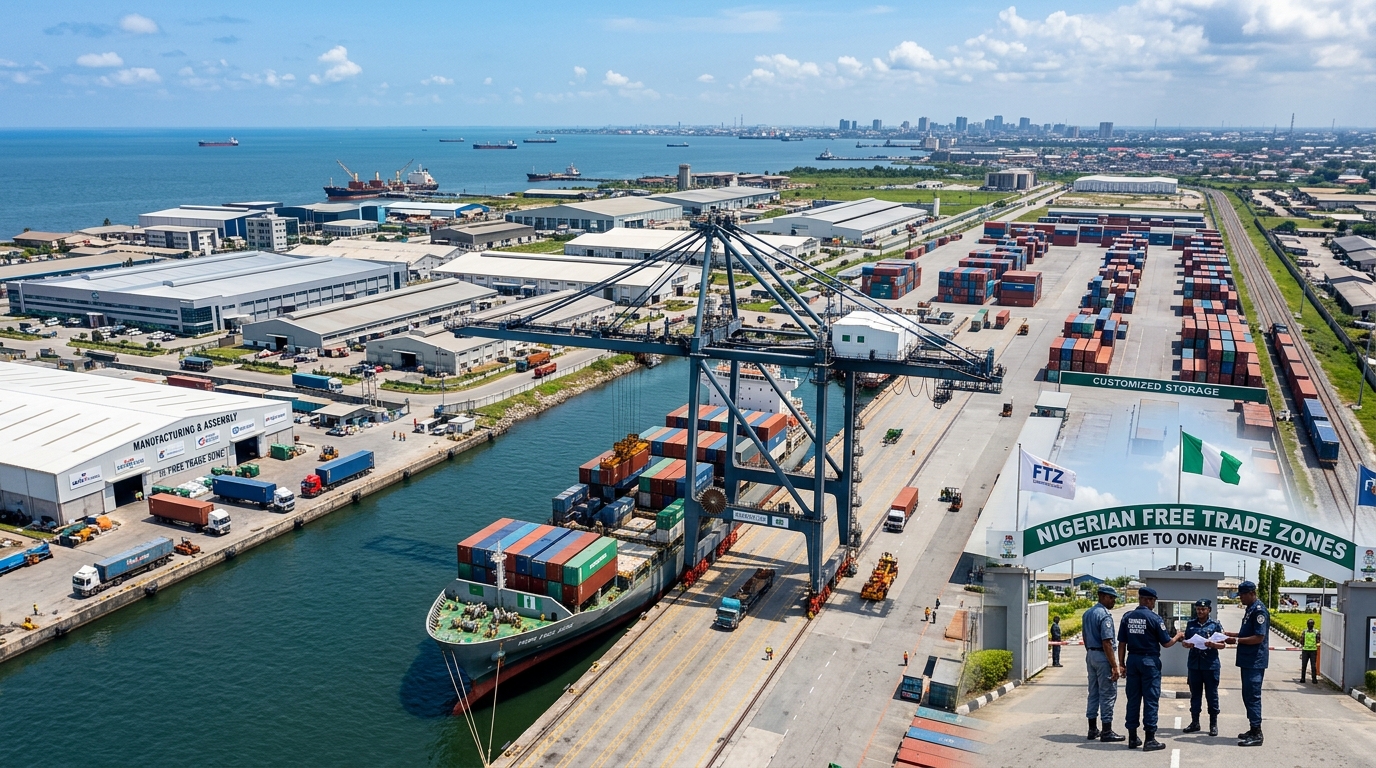
Using Free Trade Zones (FTZs) to Bypass FX Restrictions and Import Duties
Using Free Trade Zones (FTZs) to Bypass FX Restrictions and Import Duties: A Legal Playbook for Lagos, Calabar, and Kano
This article provides a strategic legal guide for using Nigeria’s Free Trade Zones (FTZs), specifically in Lagos, Calabar, and Kano, to legally navigate foreign exchange (FX) restrictions and import duties. It dissects the two primary regulatory regimes, the general FTZ regime under the Nigerian Export Processing Zones Authority (NEPZA) and the specialized Oil and Gas Free Zone regime under the Oil and Gas Free Zone Authority (OGFZA), detailing the legal pathways for goods exit, partial duty remission, and the critical, often costly, compliance pitfalls.
1. The Strategic Context: Why FTZs Are the New Frontier
With Nigeria grappling with persistent foreign exchange shortages and a high tariff wall, Free Trade Zones have emerged as critical legal conduits for import-dependent businesses and manufacturers. The core appeal lies in the exemption from standard FX regulations and customs duties for goods brought into the zones. However, the real value, and legal complexity, arises when these goods are destined for the Nigerian customs territory (the domestic market). Understanding the interplay between the NEPZA Act, the OGFZA Act, and the operational rules of specific zones in Lagos, Calabar, and Kano is not just beneficial; it is a legal necessity.
2. Understanding Nigeria’s Dual FTZ Regimes: NEPZA vs. OGFZA
Nigeria operates two parallel legal frameworks for free zones. Choosing the wrong regime for your business activity can lead to regulatory friction, denied approvals, or invalid customs exit.
2.1. The General Regime (NEPZA)
The Nigerian Export Processing Zones Authority Act, Cap N107, Laws of the Federation of Nigeria (LFN) 2004 (NEPZA Act) is the primary legislation governing most FTZs in Nigeria. Established in 1992, NEPZA licenses, regulates, and supervises all general-purpose free zones, including:
- Lagos Free Trade Zone (LFTZ) – A multi-purpose zone supporting manufacturing, logistics, and commercial services.
- Calabar Free Trade Zone (CFTZ) – Nigeria’s first operational FTZ, focused on export manufacturing and agro-processing.
- Kano Free Trade Zone (KFTZ) – Positioned as a hub for agricultural processing, textiles, and regional trade with West and Central Africa.
Under the NEPZA Act, an Approved Enterprise enjoys a suite of incentives, including: exemption from all federal, state, and local government taxes; duty-free importation of capital goods, raw materials, and machinery; unrestricted remittance of profits and dividends; and 100% foreign ownership.
2.2. The Specialized Oil and Gas Regime (OGFZA)
Separately, the Oil and Gas Export Free Zone Act, No. 8 of 1996 (OGFZA Act) established the Oil and Gas Free Zone Authority to regulate the Onne Oil and Gas Free Zone in Rivers State. Key distinctions include:
- Sector-specific scope: OGFZA is legally empowered only for oil and gas-related activities. Any purported oil and gas free zone outside Onne/Ikpokiri is legally invalid.
- Parallel authority: OGFZA operates as a separate regulator, though its Act duplicates many functions of NEPZA, leading to jurisdictional friction.
- Lagos complexities: While Lagos hosts private zones such as the Lagos Free Zone, Snake Island Integrated Free Zone, and Lekki Free Trade Zone, these are all licensed by NEPZA, not OGFZA.
- Enforcement warning: The Nigerian Senate has previously considered expanding OGFZA’s jurisdiction to include Lagos zones, creating regulatory uncertainty for oil and gas activities in Lagos FTZs.
Choice-of-regime implication: For oil and gas service companies, Onne offers a dedicated OGFZA framework. For all other manufacturing or trading activities, and for any oil-related business seeking to operate in Lagos, the NEPZA regime is the only viable legal path.
3. The Legal Gateway: Moving Goods from FTZ to Customs Territory
The legal mechanism for exiting goods from an FTZ into the Nigerian domestic market is the most critical, and most legally fraught, aspect of zone operations.
3.1. Section 18 of the NEPZA Act: The Exit Permit
Section 18 of the NEPZA Act provides the statutory authority for FTZ enterprises to sell into the Nigerian customs territory. The provision, as clarified by NEPZA’s FAQ, states: “up to 100 per-cent of production may be sold into the customs territory against a valid permit, and on payment of appropriate duties”.
This is a foundational shift from older interpretations: the 25% cap has been superseded, and a valid NEPZA permit is mandatory for any exit. Notably, Section 18 permits sales to the customs territory as a regulatory matter, but does not confer tax exemption on those sales. Once goods cross the zone boundary, they become subject to the full suite of Nigerian import duties, Value Added Tax (VAT), and potentially Company Income Tax (CIT) on the profits from those domestic sales.
3.2. Section 20: The Partial Duty Remission Rule
Section 20(1) of the NEPZA Act contains one of the most strategically valuable provisions: where goods manufactured, processed, or assembled in a free zone are exported into the Nigerian customs territory, the duty payable shall be the rate applicable to the raw materials (in the state in which they were originally introduced into the free zone), not the rate applicable to the finished product.
Practical illustration: An FTZ enterprise imports raw fabric duty-free, cuts and sews it into finished apparel, then exits the finished goods to the Lagos market. Under Section 20, customs duty is calculated on the raw fabric, not the finished garment, often a 10–15% rate differential. This partial duty remission is the legal engine of FTZ cost savings for domestic sales.
3.3. The Procedural Maze: NEPZA, NCS, and Form M
The exit procedure requires coordinated approvals from multiple agencies:
- NEPZA Approval (The Mandatory Permit): Before any goods can exit, the FTZ enterprise must obtain a written exit permit from NEPZA. No exit is lawful without this permit.
- Nigeria Customs Service (NCS) Clearance: The NCS assesses and collects the applicable duties on the exit. Customs duties in Nigeria typically range from 5% to 35% depending on the HS code of the raw material.
- Form M and PAAR Requirements: For the exit to be processed, the importer (or the FTZ enterprise acting as importer of record) must open a Form M through an authorized bank and obtain a Pre-Arrival Assessment Report (PAAR) from the NCS. The PAAR is the mandatory customs document required for all imports entering Nigeria from an FTZ.
- Exit Note and Commercial Invoice: Additional documents include a bill of lading, commercial invoice, packing list, and exit note.
3.4. Section 8 vs. Section 18: The Tax Trap
A critical legal distinction often misunderstood: Section 8 of the NEPZA Act exempts FTZ enterprises from all taxes on their approved activities within the zone. However, Section 18 permits sales to the customs territory, but this does not confer tax exemption on those sales, it is merely a regulatory permission.
Thus, when goods exit the FTZ:
- Customs duties become payable (calculated under Section 20, but payable nonetheless);
- VAT becomes payable on the value of the goods at the time of exit;
- CIT may become payable on the profits derived from domestic sales, depending on the enterprise’s overall tax status and recent tax reforms (e.g., the Nigeria Tax Act 2025 introduces performance-based incentives rather than blanket exemptions).
4. Operational Playbook for Lagos, Calabar, and Kano
Zone | Primary Strengths | Key Exit Considerations |
|---|---|---|
Lagos Free Trade Zone (LFTZ) | Proximity to Lagos seaports and airport; multi-sector manufacturing and logistics; developed infrastructure under Tolaram Group | Highest customs scrutiny due to proximity to domestic market; dedicated LFTZ Regulations 2016 |
Calabar Free Trade Zone (CFTZ) | Agro-processing and light manufacturing; access to Eastern Nigerian market; established operational history since 2001 | Lower customs traffic may reduce delays; but fewer logistics providers |
Kano Free Trade Zone (KFTZ) | Regional gateway to West and Central Africa; agricultural and textile processing focus; near-border trade advantages | Must comply with ECOWAS trade protocols for cross-border movements |
4.1. Strategic Exit Planning
- Structure as an export-oriented enterprise: Retain full tax exemptions on exports and zone-based activities.
- Quantify the raw material composition: Under Section 20, meticulous documentation of raw material origin and HS codes is essential to secure partial duty remission.
- Secure the exit permit early: NEPZA approval for each exit can take weeks; factor this into supply chain timelines.
- Consider multiple exit tranches: Enterprises may exit up to 100% of production into the customs territory with valid permits, but each tranche requires separate approval.
4.2. FX and Capital Repatriation Advantages
FTZ enterprises enjoy a liberalized FX regime:
- 100% repatriation of foreign capital investment with capital appreciation.
- Unrestricted remittance of profits and dividends.
- No import or export licenses required, bypassing bureaucratic FX allocation hurdles.
- Note on CBN access: Currently, FTZs cannot access forex directly from the Central Bank of Nigeria (CBN), though operators are advocating for offshore banking approvals to solve this. Enterprises should arrange forex through their zone-licensed banks.
5. Common Traps and Legal Pitfalls (And How to Avoid Them)
5.1. Trap 1: NEPZA Approval for Every Exit (The Most Common Failure)
The rule: No goods may leave an FTZ for the Nigerian customs territory without a valid NEPZA exit permit. This is non-negotiable. Even a single unapproved exit constitutes a breach of the FTZ license and can result in:
- Forfeiture of duty-free status;
- Assessment of back duties and penalties;
- Suspension or revocation of the Approved Enterprise license.
Mitigation: Establish an internal compliance protocol requiring NEPZA approval before any goods movement. Maintain a register of all exit permits.
5.2. Trap 2: Misclassifying Raw Materials Under Section 20
The rule: To benefit from partial duty remission under Section 20, the enterprise must accurately document the HS code and state of the raw materials at the time of entry into the FTZ. Any deviation, such as claiming raw material status for components that were already partially processed, triggers full finished-product duties.
Mitigation: Conduct a pre-exit customs audit with a licensed customs agent specializing in FTZ operations.
5.3. Trap 3: Treating Domestic Sales as Tax-Exempt
The rule: Section 8 tax exemptions apply only to activities within the zone and to exports. Domestic sales under Section 18 are not tax-exempt. Enterprises that fail to account for VAT and CIT on domestic sales face audits from the Federal Inland Revenue Service (FIRS) and potential back taxes plus penalties.
Mitigation: Separate accounting for zone-based activities and domestic sales. Remit VAT and file CIT returns for the domestic portion of the business.
5.4. Trap 4: Retail and Non-Approved Activities
The rule: “No retail trade shall be conducted within a Zone without the prior approval of the Authority”. Warehousing and transshipment are permitted; retail distribution to end consumers within the zone is generally prohibited.
Mitigation: Ensure your Approved Enterprise license specifically covers the intended activities. For distribution, exit goods to a customs territory warehouse for onward retail sale.
5.5. Trap 5: Jurisdictional Confusion Over OGFZA
The rule: OGFZA has no legal authority over Lagos-based FTZs. If an oil and gas company locates in Lagos, it must operate under NEPZA’s regulatory framework. Seeking OGFZA approvals for Lagos activities is legally invalid and may delay operations.
Mitigation: For oil and gas activities, either locate in Onne (OGFZA) or accept NEPZA regulation in Lagos. Do not mix regulatory regimes.
5.6. Emerging Traps: The Nigeria Tax Act 2025
The Nigeria Tax Act 2025 reshapes FTZ incentives by replacing broad tax exemptions with performance-based incentives. Key changes:
- Free Zone Enterprises must now derive at least 75% of income from exports to retain full tax benefits.
- Domestic sales (under Section 18) may face additional tax exposure.
- Exports by a zone entity are tax-free only for 10 years, after which up to 8% CIT will apply.
Action point: Review your exit strategy in light of the NTA 2025. Maximize export ratios to preserve incentives.
6. Enforcement and Case Law Precedents
6.1. Enforcement Actions
NEPZA has demonstrated increasing enforcement vigilance. The Authority has issued specific regulations for zones such as the Lekki Free Trade Zone Regulations 2010 and the Lagos Free Trade Zone Regulations 2016. The Nigeria Customs Service actively monitors FTZ exits, and any discrepancy between the exit permit and the actual goods triggers immediate penalties.
6.2. Judicial Recognition of NEPZA’s Exclusive Authority
Recent case law affirms NEPZA’s exclusive regulatory jurisdiction over free zones. In Centenary Economic City Free Zone v. Federal Republic of Nigeria, the court held that any encroachment on or interference with free zone land without NEPZA approval is unconstitutional, illegal, and void, citing Sections 4 and 13 of the NEPZA Act and Section 5(3) of the 1999 Constitution. Similarly, in Investors v. Wike, the court reinforced that Section 8 of the NEPZA Act explicitly exempts FTZ enterprises from state and local government levies, and any attempt to impose such levies is legally invalid.
Implication for operators: NEPZA’s regulatory authority is judicially protected. Compliance with NEPZA’s exit permit regime is not optional; it is the exclusive legal pathway for goods exit.
7. Conclusion
Using Nigeria’s Free Trade Zones to bypass FX restrictions and import duties is legally permissible, but only through a meticulously compliant framework. The correct choice of regime (NEPZA for general zones vs. OGFZA for Onne oil and gas), strict adherence to Section 18 exit permit requirements, strategic use of Section 20 partial duty remission, and careful navigation of NTA 2025 tax reforms are all essential.
For enterprises operating in Lagos, Calabar, or Kano, the playbook is clear:
- Secure NEPZA approval for every goods exit, no exceptions.
- Quantify raw material inputs to claim Section 20 duty remission.
- Separate accounting for domestic sales to account for VAT and CIT.
- Monitor the evolving NTA 2025 performance-based incentive regime.
- Engage specialized customs and FTZ compliance counsel to avoid the traps that have cost other operators their licenses and substantial penalties.
The legal architecture of Nigeria’s FTZs offers powerful tools for import duty and FX optimization, but those tools work only when wielded with precision and full regulatory deference.
References & Citations
Nigerian Export Processing Zones Authority Act, Cap N107, Laws of the Federation of Nigeria (LFN) 2004
Oil and Gas Export Free Zone Act, No. 8 of 1996
Nigeria Tax Act 2025
Centenary Economic City Free Zone v. Federal Republic of Nigeria
Investors v. Wike
Lekki Free Trade Zone Regulations 2010
Lagos Free Trade Zone Regulations 2016
Related Articles

Venture Capital in Nigeria

Strategic Compliance for Multinational Enterprises Under Nigeria’s Tax Act 2025

THE LEGAL QUAGMIRE OF ONLINE CONSUMER REVIEWS